


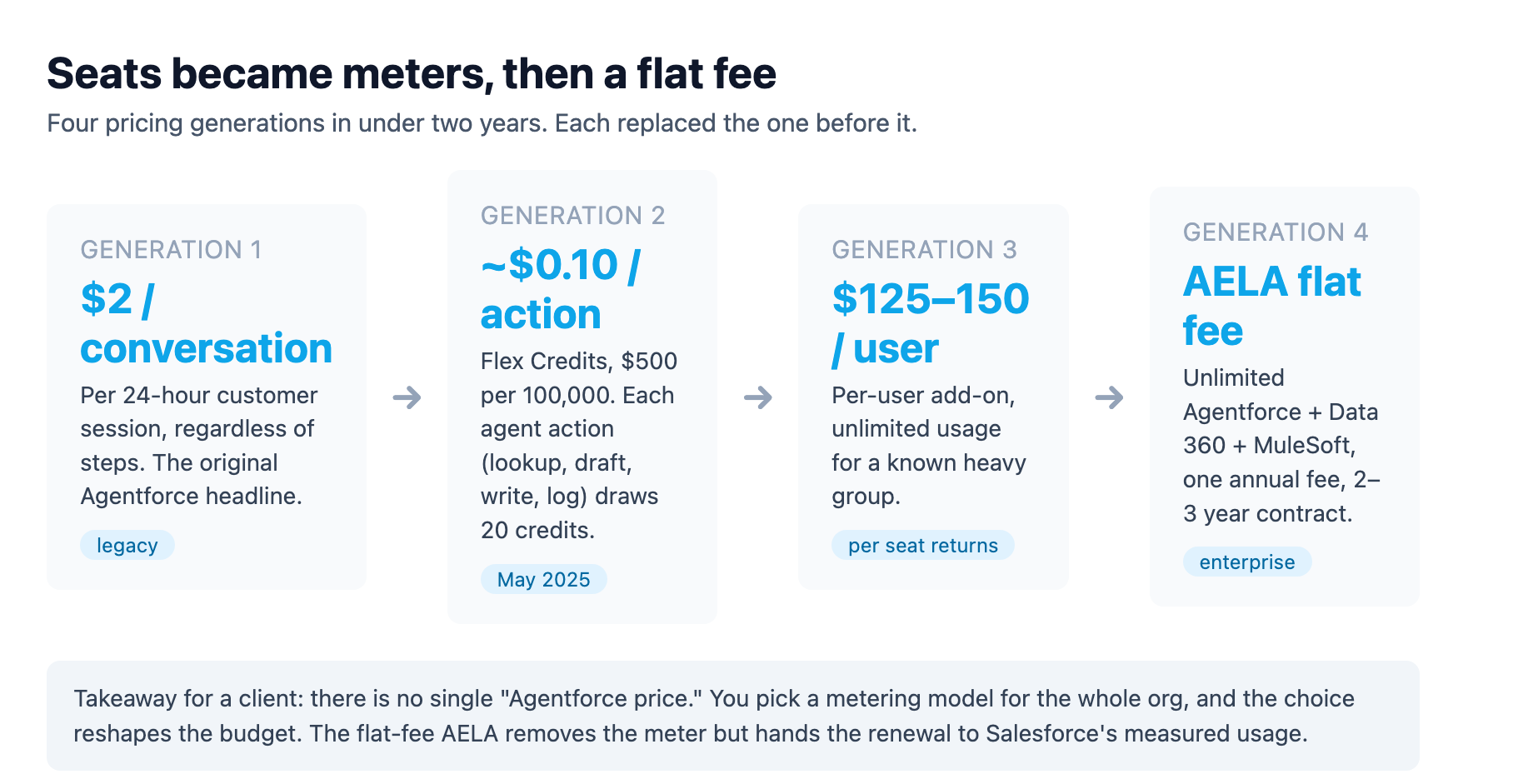
The first question a client asks us is usually "what does an agentic Salesforce stack cost?" The honest answer is that the question is unanswerable as stated, because the unit of value changed. For thirty years a Salesforce license was priced in seats: one person, one monthly fee, one predictable line item.1 The agentic stack is priced in meters. Agentforce meters agent actions. Data 360 meters the rows your operations touch. Experience Cloud meters how many people log in and how often. Each meter follows a different curve, they share one credit pool, and the model you pick for your busiest agent becomes the model your whole org pays under.2
This article is the cost layer of the Stack: not whether it works, which we covered in the build order and the failure patterns, but what it bills and how a client models it before the quote, not after the invoice. The numbers below are published list prices and third-party analyses as of mid-2026, not quotes, and your real contract will differ. What holds regardless of the exact dollar is the shape of each meter and the decision that moves it by an order of magnitude.
Agentforce: the action meter, and the org-level decision that prices everything
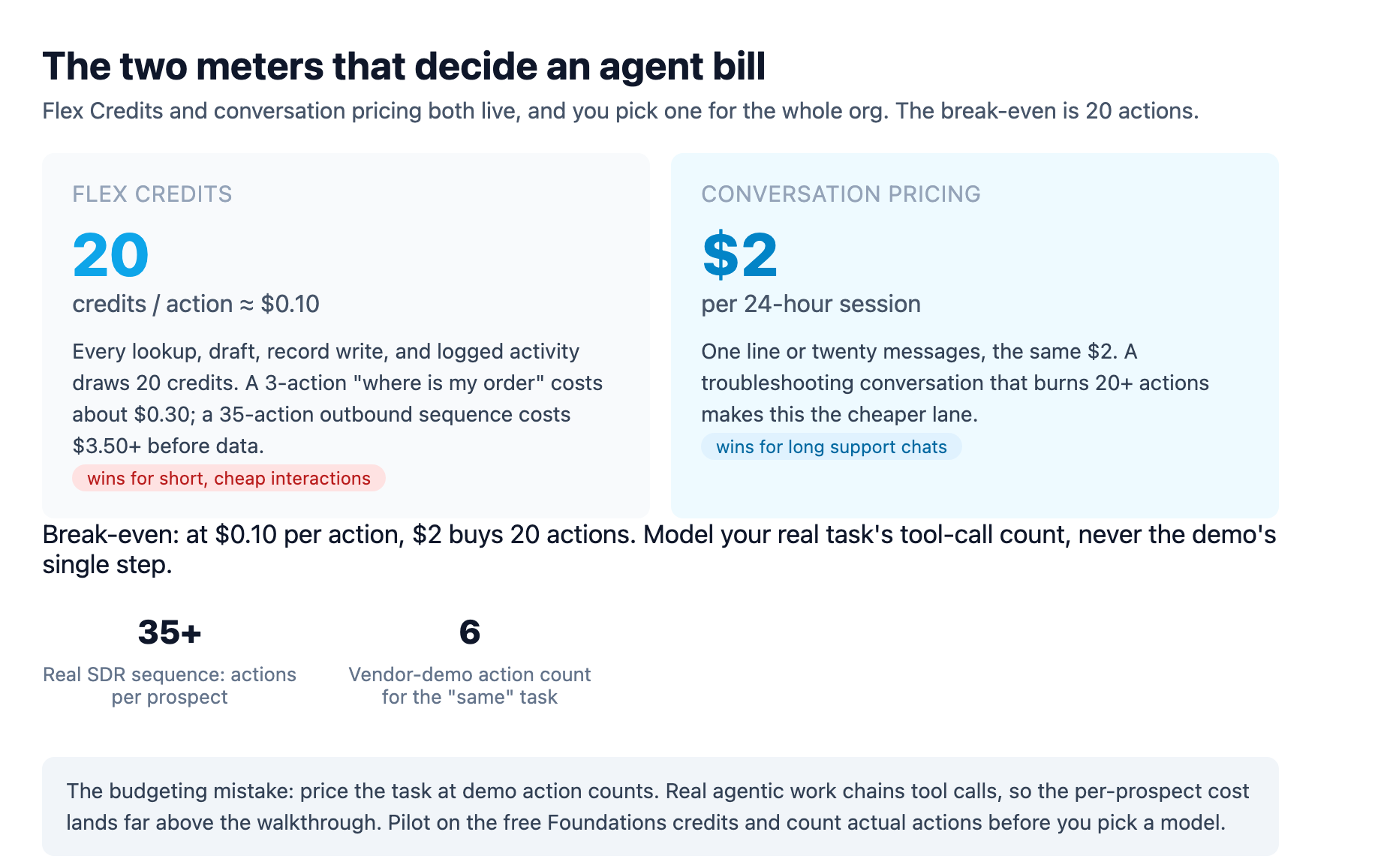
Agentforce is the layer clients quote first, and it is the one that punishes a wrong assumption. Two usage models coexist, and you pick one for the whole org, not per agent.2 Conversation pricing charges a flat $2 per customer-facing conversation, a 24-hour session between one person and one agent, regardless of how many steps it takes. A one-line "where is my order" and a twenty-message troubleshooting session cost the same $2.2 That is simple to forecast if your traffic is steady, and it is the model Salesforce carried forward from the original launch.
Flex Credits are the consumption alternative. You buy credits in blocks of 100,000 for $500, and a standard agent action draws 20 credits, about $0.10.2 An action is smaller than the demo makes it look: looking up an account is an action, drafting a reply is an action, writing that reply back to the record is an action, logging the activity is an action. A support agent that answers "where is my order" in three actions costs about $0.30. The same agent handling a return end to end, checking eligibility, issuing a label, updating the case, and emailing the customer costs five times that.2
The break-even is arithmetic: at $0.10 per action, $2 buys 20 actions.2 If your customer conversations routinely run longer than twenty steps, conversation pricing wins. If they resolve in a handful, Flex Credits win, sometimes by a lot. The catch is that you cannot run support on conversation pricing and internal ops on Flex Credits. The model that suits your busiest use case prices every use case you deploy afterward, including ones you have not designed yet.2 Run the arithmetic across your whole intended portfolio before you pick, because switching later is a commercial renegotiation, not a settings change.
Per-user licensing is the third lane for a defined group of heavy users. A basic Agentforce User License runs about $5 per user per month for access and still needs Flex Credits for the actual usage. The Agentforce add-on on Enterprise or Unlimited Edition runs $125 to $150 per user per month for unlimited usage, which makes sense when a known team of users is the workload, not a meter you can forecast.2 The bundled Agentforce 1 Editions start around $550 per user per month and fold CRM, agent license rights, and a million Flex Credits a year into one line item, a consolidation play rather than a raw AI purchase.21
The budgeting lesson, and it applies to every meter in this article, is to model your real workflows, not the demo. A vendor walks you through a single-step task and you price it like one action. Real agentic work chains tool calls. Salesforce's own sales-development illustration costs $2 as a conversation but runs three to six actions, or $0.30 to $0.60, on Flex Credits; a real outbound sequence that researches the account, drafts a personalized touch, logs it, drafts follow-ups, classifies replies, and books a meeting runs 35 or more actions per prospect, $3.50 and up before the data layer.2 Model the task you actually run, count every tool call, then multiply by volume.
Data 360: the row meter, and the five-order-of-magnitude identity gap
The cost most teams miss is Data 360, the data layer that grounds the agent. It renamed from Data Cloud in October 2025, and on March 2, 2026 Salesforce overhauled its pricing: four segmented credit types (split between sandbox and production, each with its own rule) became a single fungible pool of Data Services Credits, sold at $500 per 100,000 like Flex Credits.3 That fixes the old friction of running out of one category while holding surplus in another. It does not fix the budget risk, because credit consumption is still variable by operation, and the operation multiplier is where the money hides.3
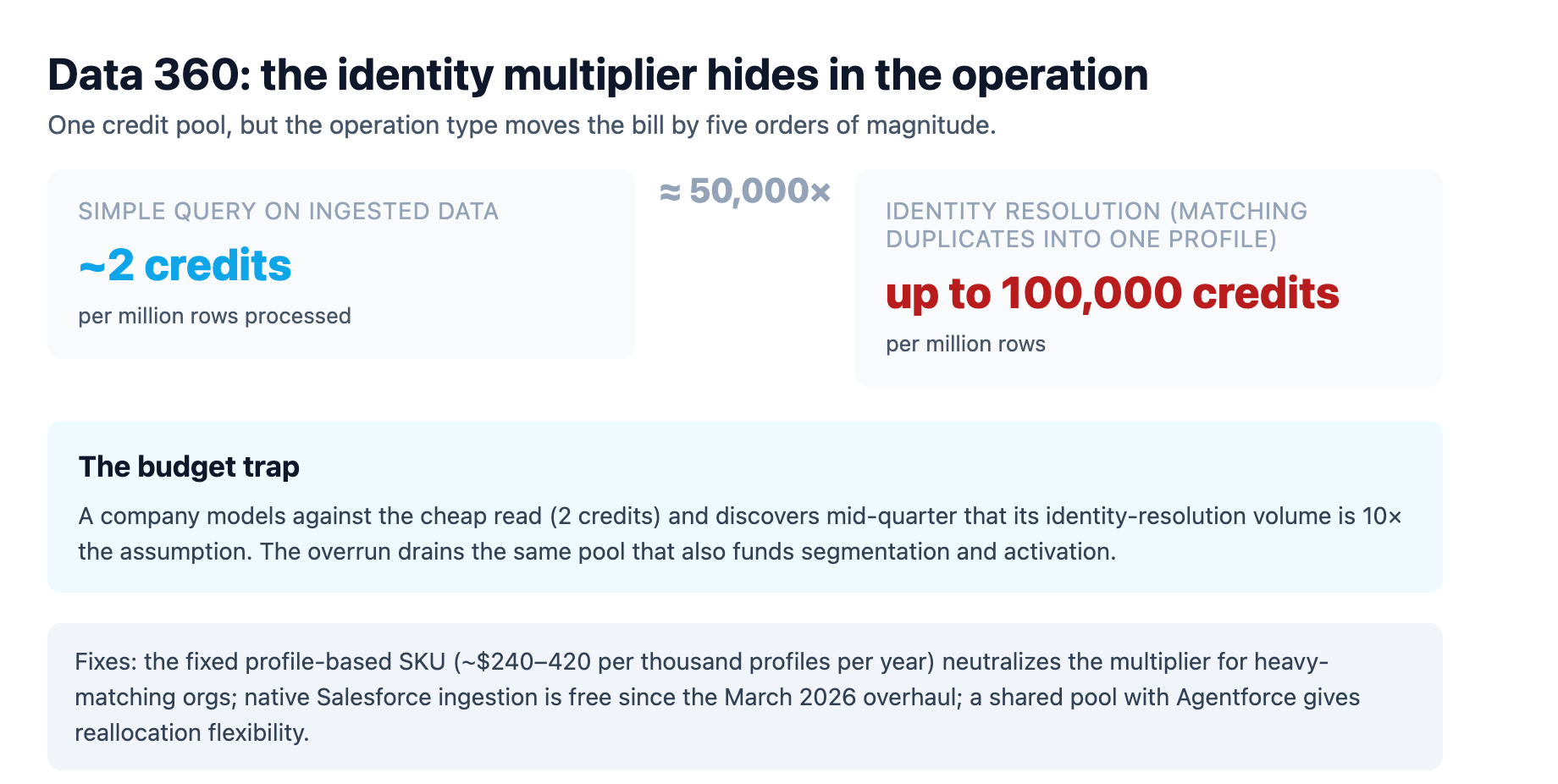
The gap is dramatic and it is the number to internalize. A simple query on already-ingested data consumes about 2 credits per million rows processed. Identity resolution, the operation that unifies duplicate records from different systems into one profile, consumes up to 100,000 credits per million rows.3 That is a five-order-of-magnitude spread: identity resolution is roughly fifty thousand times more expensive per unit of data than a plain read. A company that budgets for the cheapest use case and discovers mid-quarter that its real identity-resolution volume is ten times what it modeled gets the same billing surprise the old system produced, except now the overrun drains the same pool that also funds segmentation and activation.3
Salesforce also introduced a fixed profile-based SKU as an alternative to variable consumption, reported at $240 per thousand profiles on the baseline plan and $420 on premium, billed annually.3 Which one fits comes down to your consumption pattern. If you know your profile count and it varies little month to month, the fixed SKU gives a predictable bill even when processing volume swings. If you have a few sources and light matching, the raw credit pool is fine, because the identity multiplier never dominates. Heavy matching, multiple sources, third-party data arriving weekly, that is where the fixed SKU neutralizes the multiplier risk that would otherwise concentrate in the variable meter.3
Two more things shape a Data 360 bill. First, the credit meter is shared with Agentforce and other products, so an org already buying them gets reallocation flexibility from the common pool; one that uses Data 360 in isolation gains nothing from it.32 Second, native ingestion is free: data that already lives in Sales Cloud, Service Cloud, Marketing Cloud, Commerce, those native connectors enter Data 360 at no credit cost, answering the old complaint of paying twice for data the platform already generated.3 External third-party data still consumes credits as usual. The implementation side of all this, the sequence that keeps the identity budget from running away, is our Data 360 implementation patterns.
Experience Cloud: the login meter, and a choice that swings by an order of magnitude
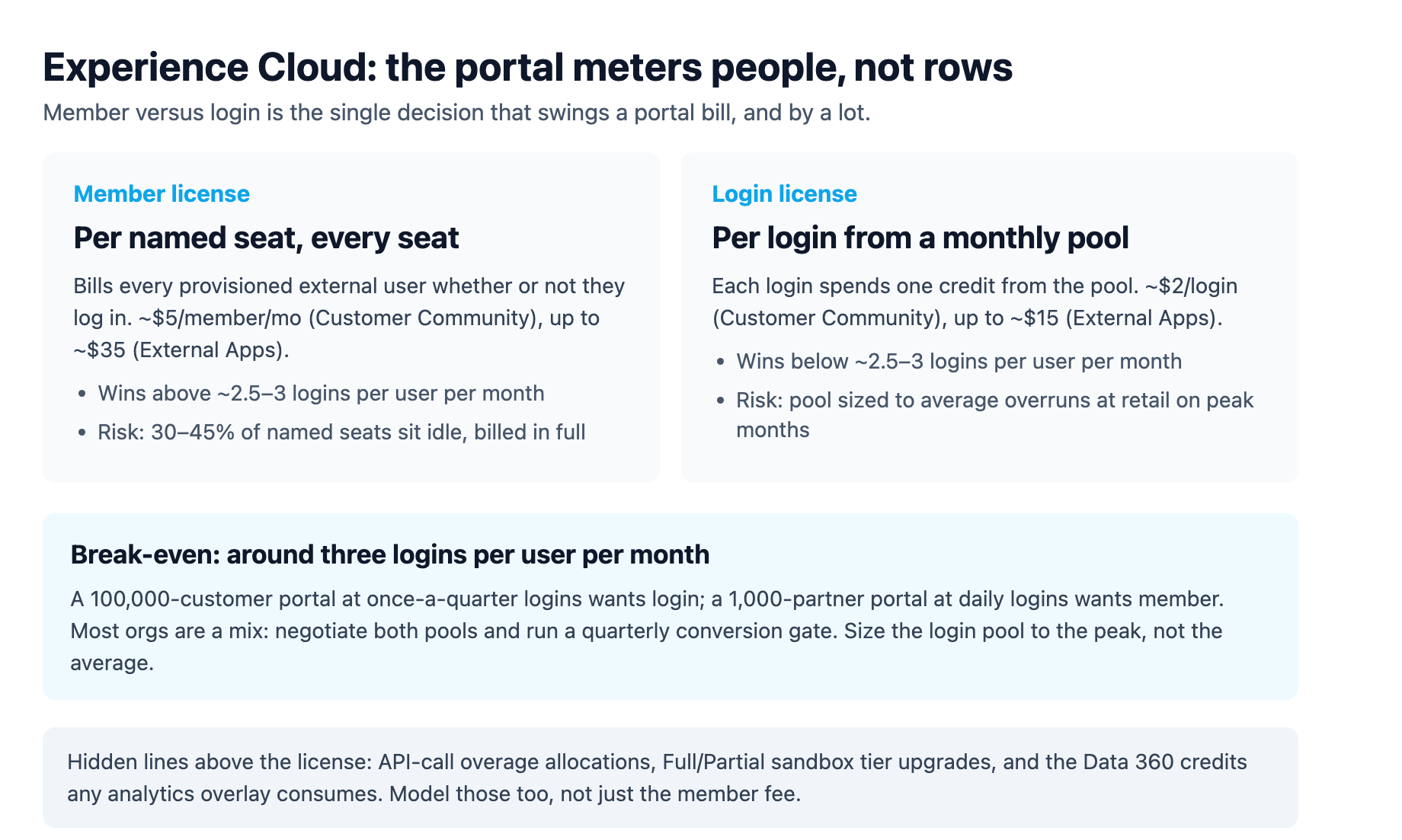
Experience Cloud, the portal layer, prices on a completely different axis that finance teams misjudge as often as they get the agent right: member versus login.45 A member license is an annual seat. Every named member counts whether they log in or not, a stable fee that quietly bills for inactive users. A login license is a monthly pool: each login spends one credit from the pool, flexible but prone to overage when a site is busier than the pool was sized for.4
The published list rates give the shape. Customer Community runs about $2 per login or $5 per member each month. Customer Community Plus runs about $6 per login or $15 per member. External Apps, the partner-grade tier, runs about $15 per login or $35 per member.5 The break-even between the two models sits around two and a half to three logins per user per month.46 A user who logs in less than that repeatedly costs far less on the login pool; a user who logs in more than that is cheaper as a named member. Most real audiences are a mix, which is why the disciplined answer is a blended model, member licenses for the regular heavy users, a login pool for the occasional ones, negotiated as two pools in one contract rather than one model for everyone.46
The scale lesson lands harder than the per-user math. A 100,000-customer portal whose users log in once a quarter pays dramatically less on per-login than on per-member; a 1,000-partner portal with daily logins pays dramatically less on per-member.6 The wrong choice, or sizing a login pool to average traffic instead of peak, is where a portal bill swings by fifty percent or more.6 And the operating failure is baked into organically grown orgs: on recent third-party benchmarks of roughly forty to fifty Salesforce engagements, member licenses sat idle on 30 to 45 percent of named seats, billed in full every year for access nobody used, because the member commitment paid for seats, not activity.4
There are hidden lines above the portal license itself. Each Experience Cloud edition includes an API call allocation, and high-traffic portals burn through it into retail-rate overage. Serious portal testing needs Full or Partial sandboxes, a tier upgrade that is rarely included in the base community license. And any analytics overlay on portal traffic goes through Data 360, which bills on its own credit model.4 A client who models only the member fee and not the API allocation, the sandbox tier, and the data overlay is modeling a small slice of the real bill. We built a full portal and Experience Cloud deployment path, and the licensing is the part the marketing pages understate.
The flat-fee alternative: AELA, and the renewal you should price before you sign
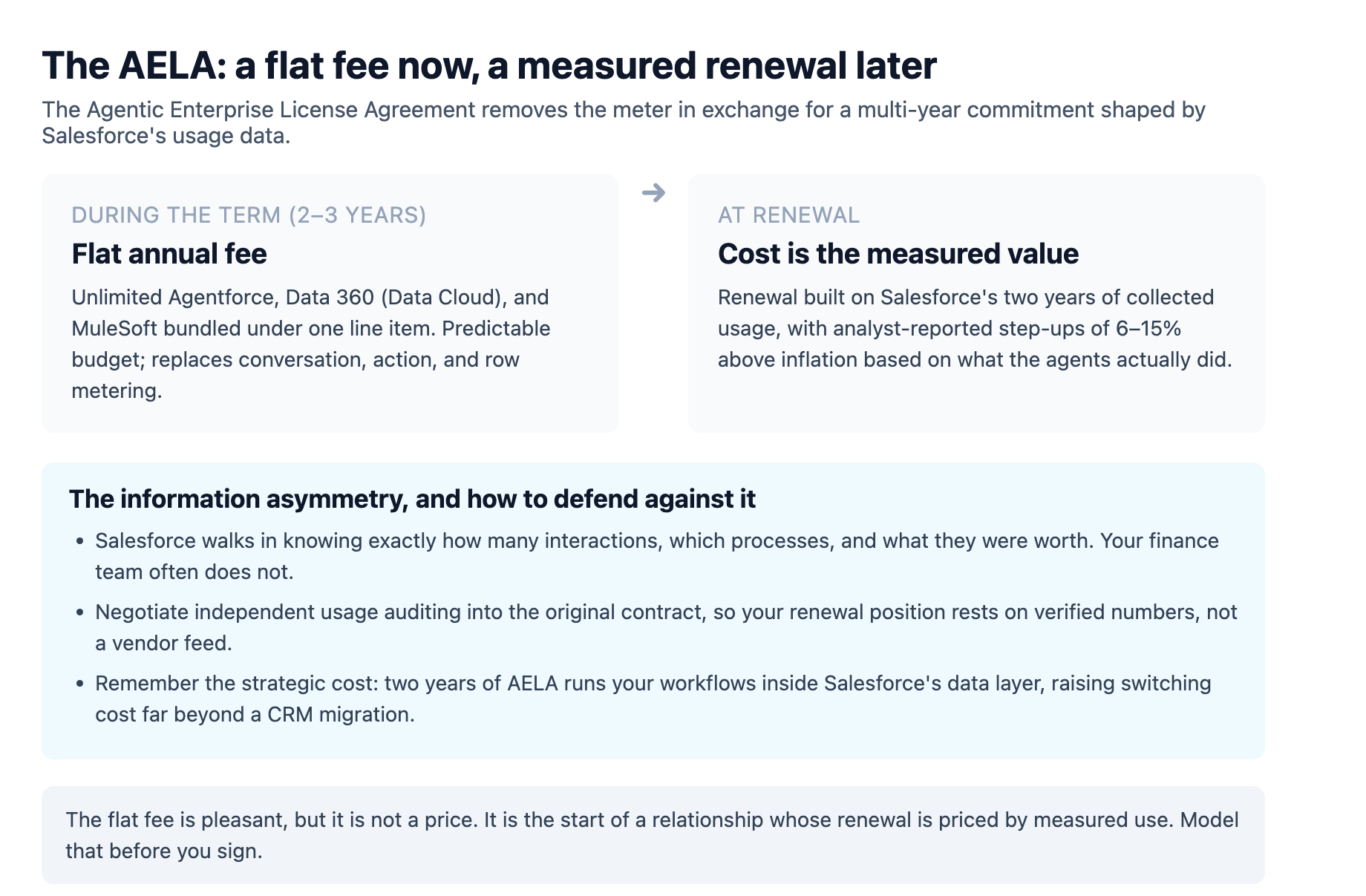
For large enterprises, 2026 brought a fourth model that replaces the meters entirely, and it deserves a sharper eye than the headlines give it. Salesforce introduced the Agentic Enterprise License Agreement, the AELA, in early 2026: a fixed annual fee covering unlimited use of Agentforce, Data Cloud (Data 360), and MuleSoft, the products that would otherwise be metered by conversation, action, or row.1 Contracts run two to three years, giving enterprise IT the cost predictability its budgets are built on, in exchange for a multi-year platform commitment. The value is real: when an agent handles millions of interactions, a consumption meter is impossible to forecast confidently, and a flat fee turns an unpredictable AI cost into a standard line item.1
The renewal is where the asymmetry shows. Gartner analyst Hannah Decker has warned that AELA renewals will be based on the actual usage Salesforce measured during the agreement, with the vendor proposing step-ups of 6 to 15 percent above inflation based on what the deployed agents actually did.1 In a traditional seat-count contract you can cut seats to lower the bill. In an AELA renewal, Salesforce holds two years of data on exactly how many agent interactions occurred, what processes were automated, and what they were worth, and it walks into the negotiation knowing more about the value it delivered than your own finance team does.1 That is an information asymmetry worth negotiating around before the signature, not discovering at renewal.
Two protections follow, and both are cheaper to obtain at contract time than after. One, negotiate independent usage auditing into the original agreement, so your renewal position is built on verified numbers, not a vendor-reported metrics feed.1 Two, remember the strategic dimension: an AELA is a commitment to run your workflows inside Salesforce's data layer, and by year three that data is business-process intelligence that would be expensive to replicate elsewhere.1 The flat fee is attractive, and it is not a price, it is the start of a relationship with a renewal shaped by measured use.
Fitting the four meters into one budget
Put the layers together and the year-one picture is bigger than any single headline. For a mid-market deployment, third-party analyses land a realistic all-in first year (licensing, data, and implementation together) somewhere in the $50,000 to $250,000 range, a wide band because the spread between a light service agent and a data-heavy outbound program is genuinely wide.7 The implementation side adds knowledge-base setup and integration work that comfortably runs five to six figures on top of the meters.7 The reported Data 360 Starter SKU lists around $60,000 a year, and real production deployments frequently grow into six figures once credits, storage, and operations are counted.7
The Lean, the model that applies to every meter in this stack, is the free Foundations tier. Salesforce gives every customer on Enterprise Edition or above a $0 allocation of Flex Credits and Data Cloud credits, plus Agent Builder, Prompt Builder, and a block of starter service, in the range of 200,000 Flex Credits and similar Data Cloud credits reported across 2026 analyses, enough to build a real proof of concept and, critically, to measure actual consumption: how many actions your real request consumes, how long your conversations run, how many Data 360 credits your workflows draw.278 That measured number, not a vendor estimate, is what you negotiate against and what you build the model on.2
The practical sequence for a client, and it is the same discipline in every layer: pilot for free on Foundations, count the real actions per task and the real identity-resolution rows, model both usage paths against your measured volume, size Data 360 separately because it is usually the largest line item, add implementation as a one-time year-one cost, and then recompute at two times and five times volume, because consumption pricing rewards low usage and punishes scale.7 Do that and the quote you sign reflects the work you actually run, not the demo you were shown. Skip it, and the first invoice tells you what the model should have been.
The arithmetic of the agentic stack is not complicated. It is just different: seats have become meters, the meters share a pool, and each one has one decision that moves it by an order of magnitude. Flex Credits versus conversation pricing for the agent, the identity-resolution multiplier and the fixed SKU for the data, member versus login and the peak-pool sizing for the portal, and the flat fee with the measured renewal for the enterprise. Model those four decisions and the budget is knowable before you sign. Leave them to the invoice and the platform decides for you.
Sources
-
Salesforce's Agentic Enterprise License Agreement (AELA): flat-fee bundling of Agentforce, Data Cloud, and MuleSoft, the renewal dynamics, and Gartner's step-up warning. techfastforward.com ↩ ↩2 ↩3 ↩4 ↩5 ↩6 ↩7 ↩8
-
Agentforce pricing in 2026: Flex Credits at $500 per 100,000, the $2 conversation model, per-user licensing, and the org-level model decision, including the 35-action SDR example. agentmarketplace.ai ↩ ↩2 ↩3 ↩4 ↩5 ↩6 ↩7 ↩8 ↩9 ↩10 ↩11 ↩12 ↩13
-
Data Cloud (Data 360) pricing overhaul of March 2, 2026: the single Data Services Credit pool, the $500 per 100,000 rate, the profile-based SKU, native ingestion, and the query-versus-identity-resolution multiplier. kliente360.com ↩ ↩2 ↩3 ↩4 ↩5 ↩6 ↩7 ↩8
-
Salesforce Experience Cloud pricing decoded: member versus login versus External Apps, API overage, sandbox tiers, the Data Cloud overlay, and the idle-member benchmark. redresscompliance.com ↩ ↩2 ↩3 ↩4 ↩5 ↩6
-
Salesforce Experience Cloud versus third-party portals: the published Customer Community, Plus, and External Apps per-login and per-member rates. thesalesforcemonk.com ↩ ↩2
-
Community Cloud license optimization: the per-login versus per-member decision and its fifty-percent-or-more swing at scale. salesforcenegotiations.com ↩ ↩2 ↩3 ↩4
-
Agentforce pricing explained, 2026: the three-layer cost stack, the Data 360 Starter figure, the year-one range, and the five-step budgeting sequence. enterprisedreamin.org ↩ ↩2 ↩3 ↩4 ↩5
-
Salesforce Foundations: the $0 allocation of Flex Credits and Data Cloud credits for Enterprise Edition customers. salesforceben.com ↩