


The pipeline didn't change. The workload did. AI coding agents are now participants in a growing share of GitHub pull requests; the number that gets quoted is 14.9% of PRs, up from 1.1% in February 2024, with the important asterisk that most of that participation is agents reviewing and commenting, not authoring 1. Meanwhile the raw volume keeps compounding: GitHub merged 43.2 million pull requests per month on average in 2025 (+23% year over year), pushed nearly a billion commits (+25.1%), and saw developers merge a record 518.7M PRs (+29% YoY) 2. New developers don't even need a decision point anymore; 80% of them use Copilot within their first week 2.
Teams that treat AI as "just another contributor" are discovering the bottleneck moved. It didn't move to code generation; that's solved. It moved to review and delivery.
The review queue is the new constraint
LinearB's telemetry across 8.1 million pull requests from 4,800+ organizations is the clearest dataset on this: AI-generated PRs wait 4.6x longer for first review (agentic-AI PRs wait 5.3x), get accepted at 32.7% versus 84.4% for human-written PRs, and are 2.6x larger at the 75th percentile, 408 lines versus 157 3. That's the shape of a triage problem: reviewers pick up AI PRs 2x faster once started, but they're skimming, not reading deeply 3.
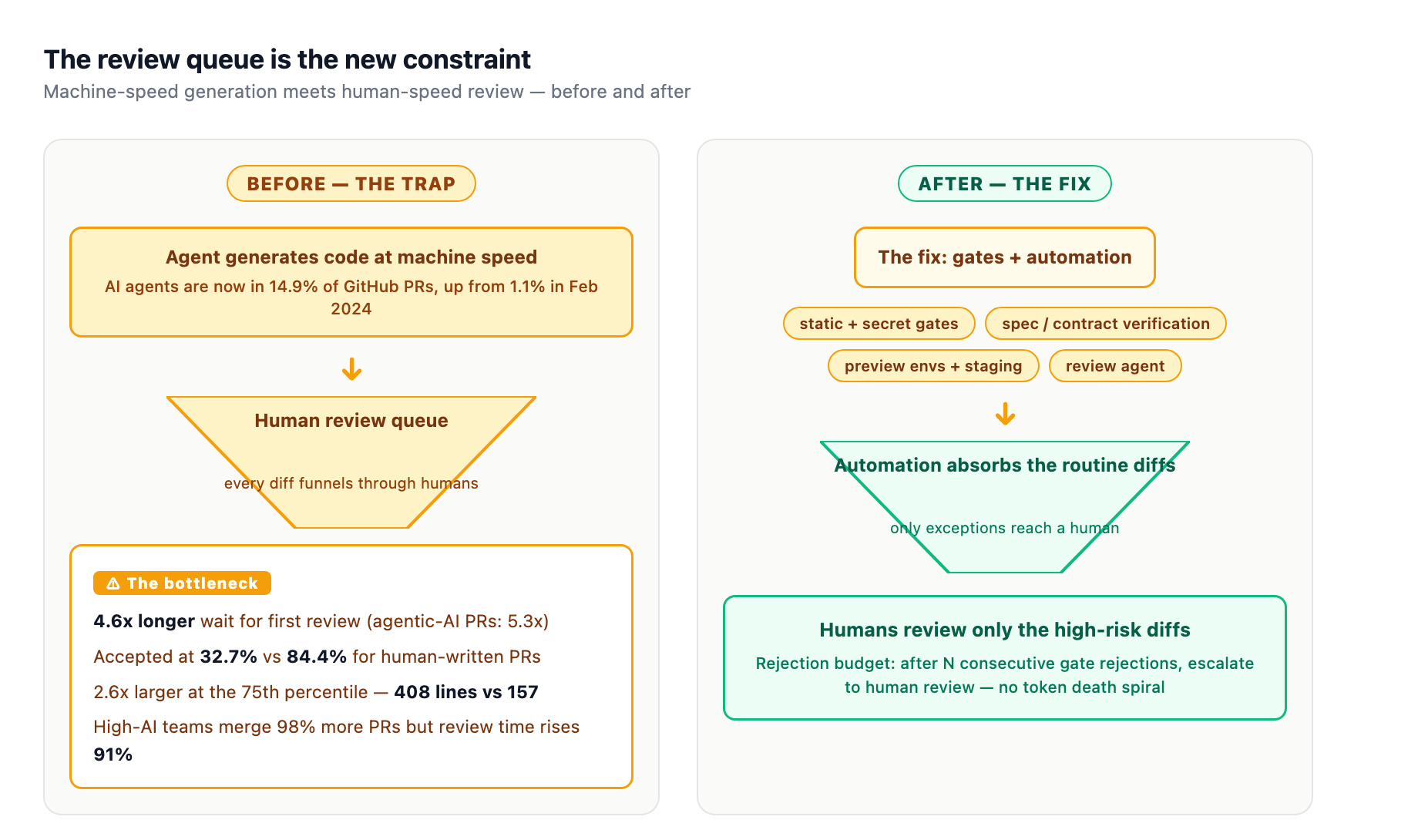
The Faros AI numbers make the trap explicit: teams with high AI adoption merge 98% more PRs, but their review time increased 91% 4. And the defects are real, not imagined: Veracode found 45% of AI-generated code introduced security vulnerabilities 3; CodeRabbit's analysis of 470 real PRs found AI-co-authored PRs carrying 1.7x more issues (1.75x more logic and correctness errors, 1.64x more code-quality problems, 1.57x more security findings), with XSS appearing 2.74x more often and improper password handling 1.88x more often 4. A study of the AIDev dataset (24,014 merged agentic PRs) confirms agent PRs are structurally different from human ones, most significantly in commit count (Cliff's δ = 0.54), so the reviewer can't rely on "it looks normal" 5.
The downstream damage is measurable: 72% of organizations report at least one production incident caused by AI-generated code, and 45% of deployments involving AI-generated code lead to problems 3. Worst of all, 43% of AI-generated code that passes QA and staging still requires manual debugging in production, and verifying a single AI-suggested fix averages three redeploy cycles 3.
What actually changes in CI/CD
The fundamentals don't change: build, test, validate, stage, deploy. What changes is that every stage has to run automatically and reliably at much higher volume, because agents can read a failing check, fix it, and resubmit on their own, turning CI from a gate into a feedback loop 6. Four things move from "nice to have" to "non-negotiable":
1. Mandatory, fully automated PR validation. Linting, dependency vulnerability scanning, SAST, and secret scanning on every agent PR. Northflank's enterprise guide is blunt that secret scanning on agent PRs is not optional; agents commit credentials more often than humans do, and the check must block merges at the infrastructure level, not rely on the agent 7. Same for PR policy gates: agent PRs go through the same review as human PRs (owner review, coverage thresholds, lint, SAST, secret detection), with no pilot exemptions, overrides tied to a named role, and every bypass logged. Label agent PRs with the tool and session ID (e.g. agent:claude-code) so you can pivot from a PR to the originating session in your SIEM 7. The supply-chain side of these gates, dependency locking and scoped secrets, is part of the wider hardening covered in our GitHub Actions 2026 security roadmap walkthrough.
2. Preview environments are no longer optional. AI modifies multiple services and config files in a single change, so "it passed unit tests in isolation" means little. Every PR should deploy its own isolated copy of the application with production-like config, isolated databases, and automatic cleanup 6.
3. Instant rollback. Changes span multiple services and are hard to diagnose on the spot. The safest workflow: roll back production first, restore service, then investigate and generate the fix 6.
4. Gates that verify intent, not just syntax. The failure mode traditional CI misses is spec drift: code that compiles, passes type checks, and passes tests, but quietly violates the contract it was supposed to implement 8. Augment Code's framing is the one worth stealing: "A diff-level reviewer sees that the code compiles. The Verifier sees that the endpoint no longer enforces the validation contract." Their failure-mode table is the best short taxonomy I've seen: spec drift, infrastructure assumption mismatch (code passes in isolation, RBAC/storage wrong in the target environment), invisible SLO degradation (each PR passes, the error budget erodes), hallucinated dependencies (commercial models hallucinate package names at a rate of 5.2% or higher), and prompt injection via repository content 8.
The gate stack that ships agent code safely
Putting the research together, a production-grade pipeline for AI-generated code looks like:
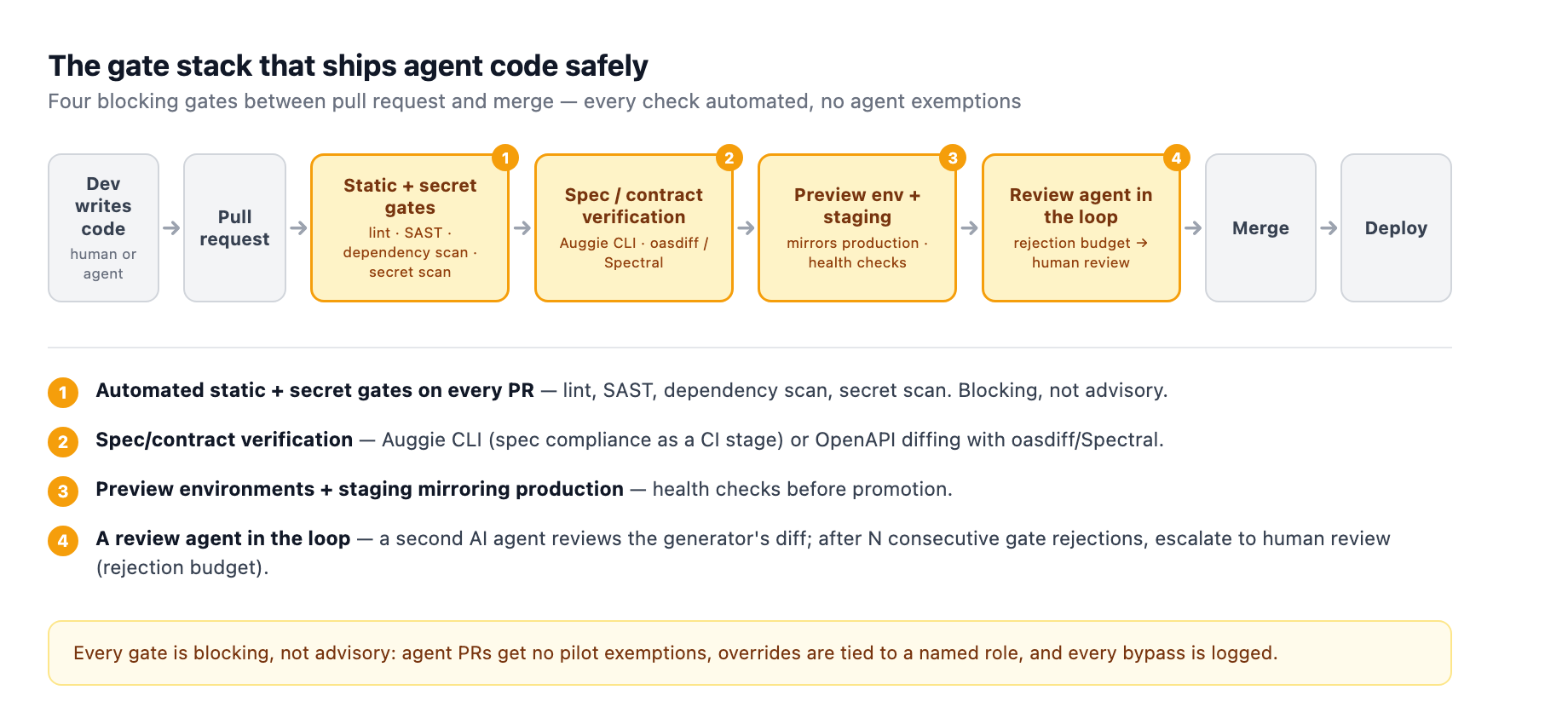
- Automated static + secret gates on every PR (lint, SAST, dependency scan, secret scan), blocking, not advisory 7.
- A spec/contract verification stage: either a tool like Augment's Auggie CLI (spec compliance as a CI stage) or OpenAPI diffing with oasdiff/Spectral 8.
- Preview environments + staging mirroring production, with health checks before promotion 6.
- A review agent in the loop: the pattern of a second AI agent (ideally a different model) reviewing the generator's diff, because a critic and a generator have different failure modes 4. Teams running fully autonomous pipelines add a rejection budget: after N consecutive gate rejections, escalate to human review, preventing the "token death spiral" of infinite retries 4.
- Named ownership. 88% of enterprise AI agent pilots never reach production, and 56% of organizations that successfully scale AI agent programs name a dedicated owner 7. Gartner predicts over 40% of agentic AI projects will be canceled by the end of 2027, not because the models are bad, but because the risk controls around them weren't built 7.
Adroit on the Ground: what our own pipeline does
We run an agent delivery pipeline in our own shop, a kanban chain where specialist profiles produce deliverables that flow through QA with a phase-gate: QA reviews, blocks the task on findings, and a fix task loops back until approval, per our internal QA pipeline lifecycle. We learned the "it compiles, tests pass" trap the expensive way: a local model once emitted empty {} objects for nested tool-call arguments, silently breaking our completion gate; free-text reasoning stayed correct while the structured output was garbage. Our fix was architectural: move structured/tool-call workloads to cloud models, keep local for free-text subsystems, and never trust a gate that validates only the shape of output rather than its meaning, as we documented after our kanban completion-gate failure (t_db6b0a22).
The same principle runs through how we ship this blog. Our publish flow is deliberately mechanical: write MDX with strict frontmatter → regenerate the post index at build time → commit → push → Vercel auto-deploy, via our repo's build-posts.js pipeline. And we verify a deployed post with a layered check (curl the live URL, confirm the slug on the index, check the feed) rather than trusting a single fetch, because Vercel's edge cache can 404 a brand-new route for minutes while the index already lists it, per our internal live-app-verification runbook. A gate that checks the artifact, not the pipeline's self-report, is the difference between "we pushed it" and "it's actually serving."
The bottom line
AI-generated code isn't going to slow down; the volume data says the opposite. The teams that ship it safely aren't the ones with the best model; they're the ones who made their pipeline the last line of defense: blocking secret/static gates, preview environments, spec verification, staged promotion, instant rollback, and a named owner. Build those first, and the agent PRs can flow as fast as they're generated.
Note: aggregate statistics (LinearB, Veracode, CodeRabbit, Faros) are reported via the Encore "State of AI-Native Software Delivery 2026" synthesis and the BuildMVPFast review-agent guide, cross-checked against the underlying vendor pages where accessible. Re-verify any figure before reuse in client proposals. Fortress references reflect Adroit's internal systems, generalized for confidentiality.
Sources
-
reddit.com. reddit.com ↩
-
github.blog. github.blog ↩ ↩2
-
buildmvpfast.com. buildmvpfast.com ↩ ↩2 ↩3 ↩4
-
northflank.com. northflank.com ↩ ↩2 ↩3 ↩4
-
augmentcode.com. augmentcode.com ↩ ↩2 ↩3