


The demo goes great and adoption tanks. That is the scenario Robbin Schuurman opens his May 2026 Scrum.org analysis with: a product owner walks stakeholders through three AI-polished features, the room applauds, and two weeks later all three sit under fifteen percent adoption1. The review measured satisfaction with the presentation, not with the product, and that confusion is about to get worse. Coding agents compressed the building part of delivery to near-zero, so the constraint moved upstream to the part agents cannot do: agreeing on what matters and checking that users actually use it. Scrum's ceremonies were built to track human implementation effort, and they were never designed for a team that generates code in seconds. The sprint review is the first one to break.
The premise that broke
Scrum's ceremonies exist to inspect and adapt work produced by humans. That premise quietly stopped holding. getDX's 2026 analysis of software project management reports global code volume up an estimated 2.5 times while successful delivery has not followed a linear path, and roughly 40 percent of agentic automation projects miss their ROI targets2. The primary cause, it argues, is not model capability but structure: teams automate broken processes instead of redesigning them for a human-agent reality where the bottleneck is verification, not production2.
The planning literature has named the same shift. An IJETCSIT paper on agent-assisted development, cited in Augment Code's 2026 sprint planning guide, puts it plainly: agent-assisted development shifts the bottleneck from code production to oversight, verification, and constraint design3. When an agent can turn a three-point story into code in four seconds, the old measurement logic collapses. Scrum.org's Sanjay Saini makes the point concretely: a velocity that jumps from 50 to 5,000 in one sprint is not a hundred times more value, it is a broken metric4. The scarce, expensive resource in delivery is no longer hours of developer output. It is the attention of the people who decide what is true and what is worth shipping.
The verification load is the proof. getDX reports that in mature AI-native organizations the ratio of review time to coding time has shifted from 1:4 to 3:1, and that a developer reviewing a thousand lines of AI-generated code spends more mental effort than writing two hundred lines of their own2. When review becomes the tax, and the humans who clarify requirements and approve bets are the ones who can remove ambiguity, stakeholder alignment stops being a soft skill and becomes the critical path.
The sprint review is the weakest link
Of all the ceremonies, the sprint review is failing hardest, because it drifted into a demo long before AI existed. Schuurman is careful to note the Scrum Guide never used the word demo; it describes the event as a working session where the team and stakeholders inspect the outcome and decide what to adapt1. Practice drifted. Three forces kept the demo alive: it is easy to produce, stakeholders are trained by decades of corporate ritual to expect it, and a round of applause is easier to read than real outcome data1. AI makes the first force trivially strong. An agent can polish a demo flow, script the walkthrough, and render a feature to look its best in under an hour1. Polish was always a proxy for quality, and polish is now cheap. A team can bring a pristine demo to a sprint review every two weeks and never produce a validated outcome.
The fix Schuurman proposes, worked out with a room of Professional Scrum Trainers, is an Evidence Review: the same working agenda sharpened for an AI-powered team1. Four questions, asked in order, every sprint, without exception. What did we bet? What did we ship? What did users do with it? What is the next bet?1. The first two are a deliberately small rear-view mirror, brief and factual. The third is the heart of the event, adoption data, cohort analytics, support ticket deltas, and if the team does not yet know the answer, that gap becomes a Product Backlog risk, deliberately1. The fourth produces at least one candidate for the next refinement, because an event that ends without a decision is a status update with extra steps1.
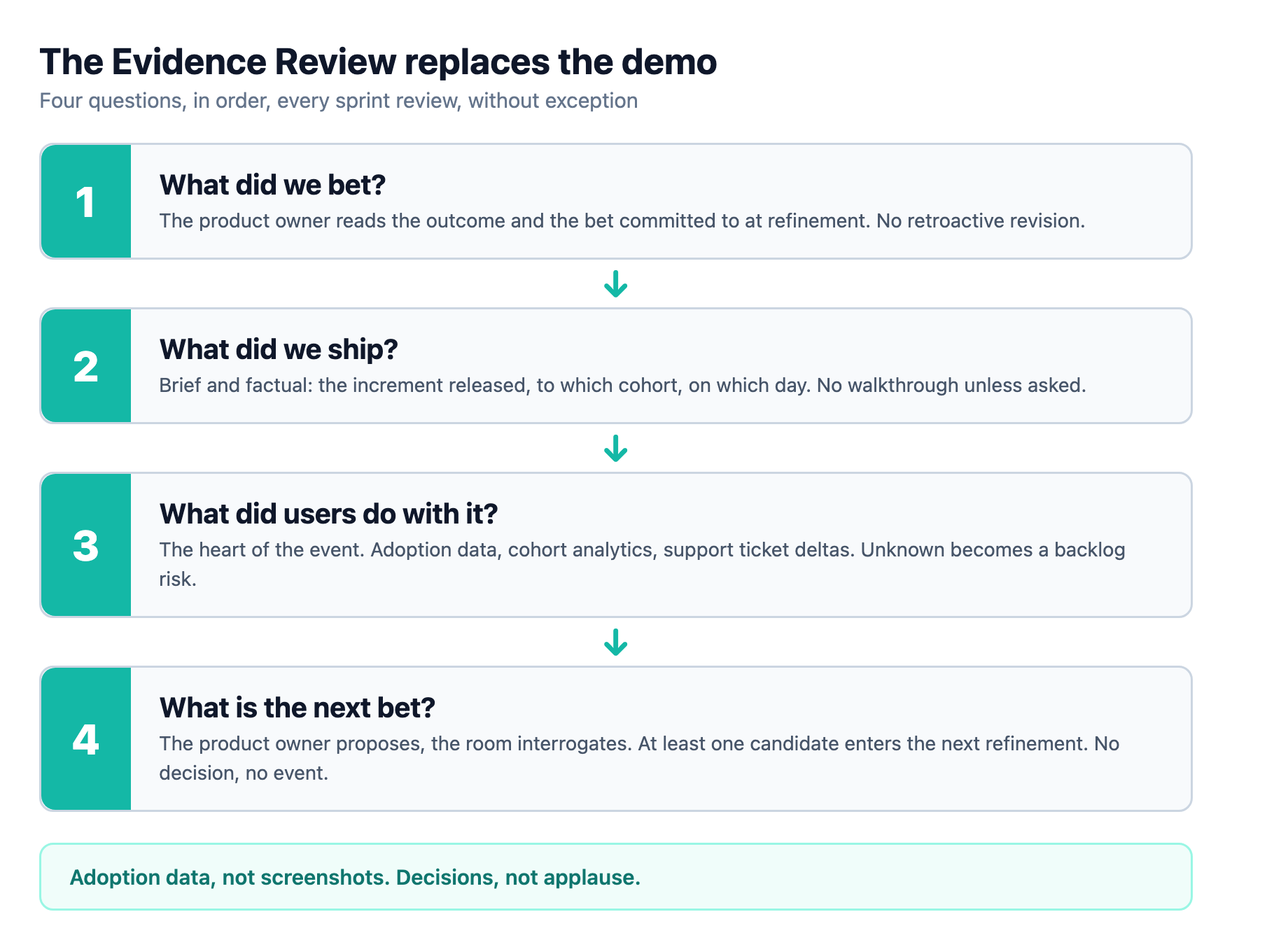
The concrete example from the piece is worth holding onto. A SaaS onboarding team's product owner opens the review with the bet that removing friction would move activation from 42 percent to 60 percent. She shares what shipped, to which cohort, on which day. Then the adoption data: seven-day activation at 47 percent, not 60, support tickets unchanged1. She proposes the next bet, that uncertainty rather than friction was the blocker, and a sales stakeholder challenges the hypothesis with three lost-deal transcripts. The event ends on time, no applause, two concrete decisions on the table1.
Where agents help, and where they must not
Agents are genuinely useful inside an Evidence Review. They can roll up adoption dashboards, synthesize cohort comparisons, and generate the first-draft analysis of why a bet moved1. They can prepare the materials. What they cannot do is present, narrate, or stand in front of stakeholders. The product owner owns the evidence narrative, because accountability concentrates rather than dissolves; an agent that summarizes the data is a useful assistant, but an agent that delivers the review is an accountability leak1.
This is the stakeholder-side twin of the requirement-gap argument. Our earlier analysis of the AI requirements bottleneck traces how coding agents moved delivery pressure upstream to specification, where there is no oracle for correctness other than the user1. On the stakeholder side, that gate lives in the review, which is why human sign-off on what was intended remains the acceptance gate. Agents are also bad at reading the room. Experienced stakeholders communicate as much in what they do not say, and naming a pointed silence out loud is a human skill, not an agent one1.
Planning becomes intent design, standups become telemetry
The sprint review is the sharpest case, but the pattern runs across the ceremonies. Sprint planning's central skill is shifting from effort estimation to task attribution, and the industry is renaming the event3. AWS guidance, reported by InfoQ, holds that sprint planning must evolve into intent design, a session about oversight, verification, and constraints rather than effort arithmetic3. The 2020 Scrum Guide already lets the team invite others to provide advice, which is the seam agents now slip through3. Vendors ship agents inside the ceremony: Atlassian's Rovo generates sprint goals and checks work readiness, Linear treats agents as first-class users, and GitHub's coding agent picks up issues directly3. The boundary that keeps it advisory is the three things the guide keeps with humans: the sprint goal, the sprint backlog, and the definition of done3.
The daily scrum is next to go. getDX argues that daily standups, designed for human-only teams, are increasingly replaced by real-time telemetry from agentic workflows, which provide a more accurate progress signal than a manual update2. Even where teams keep a synchronous standup, its content changes. The point stops being I did X, I will do Y and becomes I need help with this, who can review by end of day, is anyone blocked by me5. Status reporting is what agents and dashboards are for now. The human minutes in a standup are for dependencies and decisions.
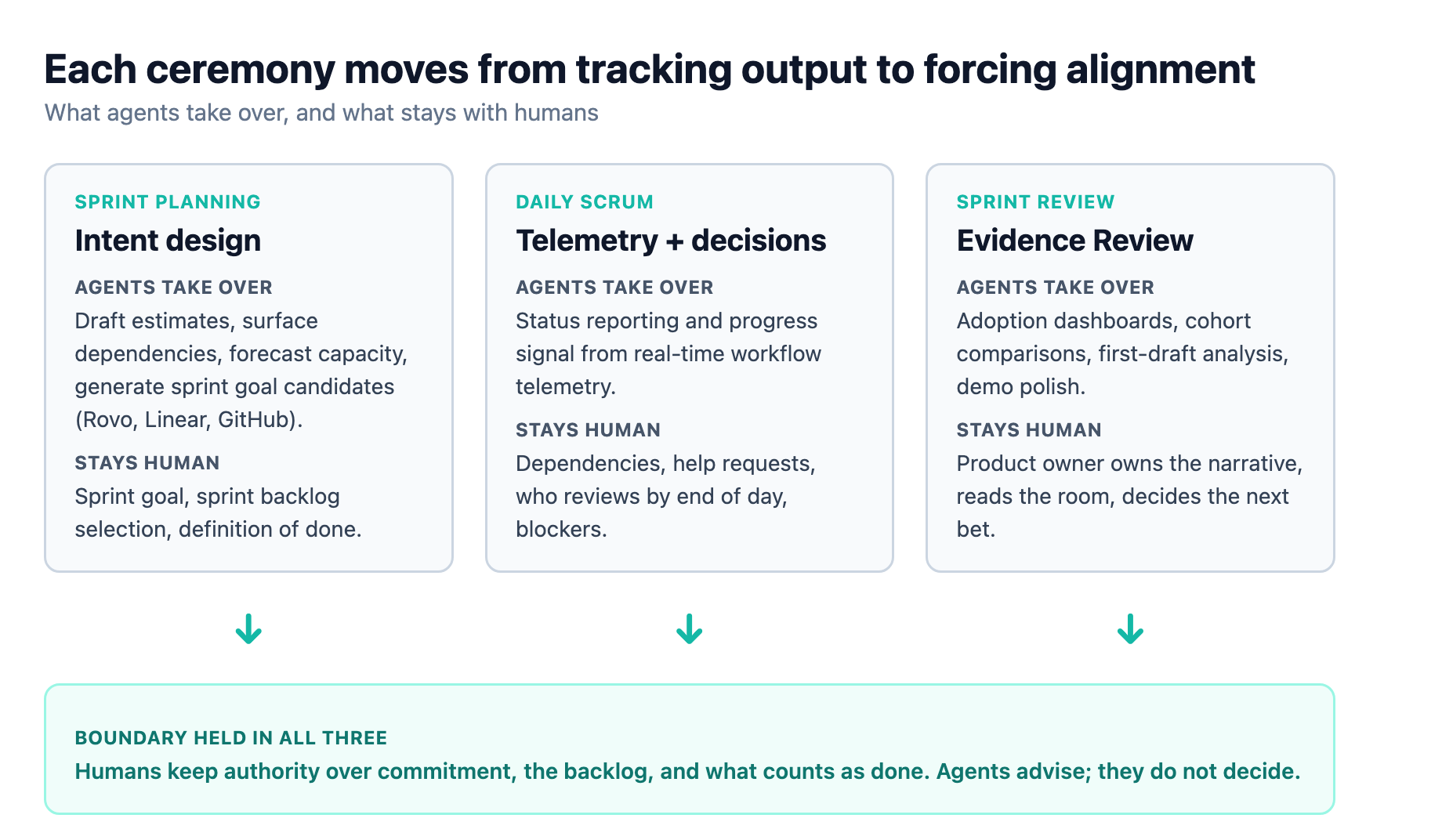
The throughline is that each ceremony moves away from tracking output and toward forcing alignment. Vague specs stop being a nuisance and become compute waste, because an agent acts on the letter of a requirement, and vague burns tokens and produces drift2. Teams that keep story-point velocity as their steering metric are flying blind. The agent efficiency score and human-agent handoff time that Saini proposes in the Evidence-Based Management space answer the question that actually matters: whether the tool is saving work or creating noise4.
A playbook for the next three sprints
None of this requires abandoning Scrum. It requires running the existing events for the job they now have. Start with the sprint review. Print the four questions, put them on the wall, and walk them in order for three sprints straight1. Bring adoption data, not screenshots; if you cannot answer what users did with the feature, say so and make the gap the next backlog risk1. Track decision-latency, how fast the event produces a decision the team can act on, instead of attendance or satisfaction1.
Second, write down the agent boundary before the next planning session. Decide which agent suggestions auto-apply, which need approval, and how much agent output your human review capacity can absorb3. Cap agent-generated work at what the team can review; rubber-stamping AI code to keep up with velocity is how change failure rate climbs2.
Third, change what you measure. Retire velocity as a commitment anchor and move to the outcome measures the ceremony redesign implies: adoption on shipped features, decision-latency in review, agent efficiency score, and human-agent handoff time4. Fourth, let the standup go asynchronous where the team is distributed, or at minimum let the tooling own the status part and spend the human minutes on dependencies and help requests25.
The pitfalls are mostly the habits the old rituals trained us into. Do not force agents into synchronous human meetings as a display of control; redesign the workflow asynchronous-first2. Do not mistake passing builds for validated outcomes; an agent can make the demo beautiful and the feature unadopted1. And do not let the review measure satisfaction with the presentation, because that is exactly the number that looks great in the room and means nothing two weeks later.
The cost of staying in demo mode, measured in unadopted features and unhappy stakeholders, has become impossible to ignore1. Scrum does not need a new framework. It needs its existing events run for the constraint that actually binds now: not building, but aligning. The team that replaces its demo with an evidence review, its status standup with a decision forum, and its velocity with adoption and decision-latency is not abandoning agile. It is finally running agile for the way the work is actually done in 2026.
Sources
-
Robbin Schuurman, "The Future of AI-Powered Product Development: The Sprint Review Is Broken, Here Is What Replaces It," Scrum.org, May 14 2026. scrum.org ↩ ↩2 ↩3 ↩4 ↩5 ↩6 ↩7 ↩8 ↩9 ↩10 ↩11 ↩12 ↩13 ↩14 ↩15 ↩16 ↩17 ↩18 ↩19
-
"Software project management in 2026," getDX, January 16 2026. getdx.com ↩ ↩2 ↩3 ↩4 ↩5 ↩6 ↩7 ↩8
-
Paula Hingel, "AI Sprint Planning With Agents: A Practical 2026 Guide," Augment Code. augmentcode.com ↩ ↩2 ↩3 ↩4 ↩5 ↩6 ↩7
-
Sanjay Saini, "From Velocity to 'Agent Efficiency': Evidence-Based Management for the AI Era," Scrum.org, January 22 2026. scrum.org ↩ ↩2 ↩3
-
"How AI is Transforming the Daily Standup for Scrum Masters," AgileSeekers. agileseekers.com ↩ ↩2