

The schedule stopped being about the code, and nobody updated it. I sat in on a delivery review for a client transformation where the build team had gotten frighteningly fast. Features that used to take a week were appearing in days. Yet the engagement kept slipping, and the slippage had nothing to do with engineering. Every blocker in that room was a person: a product owner who had not confirmed the acceptance criteria, a compliance lead who needed one more walkthrough, a sponsor who wanted the scope question answered before he would greenlight the next increment. The team could out-produce its own stakeholders, and it had no idea what to do about that.
This is the delivery reality of 2026 for consulting teams. The tools automate the parts of project management that used to eat a project manager's week, and coding agents compress the build. What neither can do is make a room full of humans agree. That makes stakeholder management the constraint on delivery speed, not a soft-skill afterthought. This article is about why that happened and how consulting teams run it as a critical-path discipline.
The PM job that got automated
Project managers spent more than half their time on work that did not move a project forward. One 2026 analysis puts it at 54 percent of the working day consumed by status meetings, manual updates, resource tracking, and report generation1. AI project management tools take exactly that work off the table. Status reporting that took four hours a week drops to about thirty minutes of reviewing and approving generated output, and the same guide reports two to five hours of recovered capacity per project manager per week from reporting, meeting notes, and routine updates1.
The direction of travel is not subtle. Gartner expects 40 percent of enterprise applications to embed task-specific AI agents by the end of 2026, up from under 5 percent in 2025, and projects that by 2030 some 80 percent of project management tasks will be run by AI1. The scheduling, the tracking, the status summarization, the risk flagging: all of it is becoming machine work.
The useful way to draw the line comes from the same guide. Automate the tasks that produce a document or a number, and keep the tasks that produce a commitment1. A status report is a document. A forecast is a number. A scope decision or a sign-off is a commitment, and no agent is taking it. The pattern that works is that AI handles the data-heavy repetitive work and the project manager reinvests the freed hours into the judgment and relationship layer1.
So the project manager's job is not disappearing. It is being stripped down to its hardest part. When the scheduling and the reporting are automated, what remains is stakeholder alignment, conflict resolution, and the final go or no-go calls, the work that determines whether a project succeeds1. That is a smaller job in volume and a larger one in consequence.
Code got cheap, so alignment got expensive
The second shift is the bigger one, and it comes from the engineering side. Coding agents collapsed the cost of producing working software. Our piece on the requirements bottleneck makes the case: when implementation gets fast and cheap, the delivery constraint moves upstream to specification. And specification is a stakeholder problem. The person who knows what the business actually needs, who can say what good looks like, and who can approve it, is a human in the client organization, not a tool on the team.
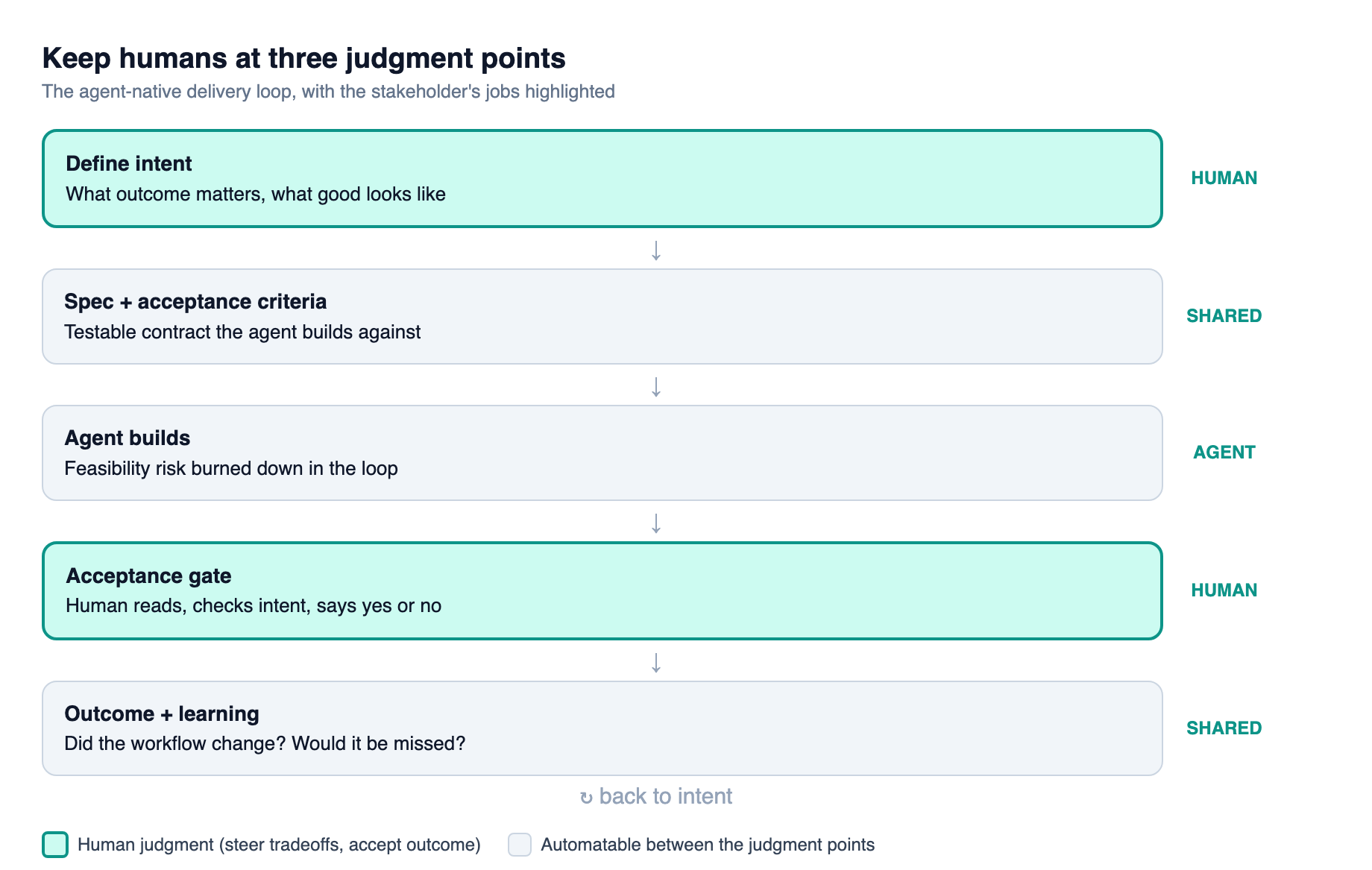
Yuval Yeret frames the consequence sharply in his spec-driven development writing. An AI coding agent can burn down feasibility risk on its own, try an approach, inspect the error, adjust, and try again2. That agentic loop is genuinely useful. But a coding agent is not a product agent or an outcome agent. It can build what you asked for and still miss the outcome, because it cannot know whether customers want it, whether users trust it, or whether the workflow will actually change2. Working software is not the same as a valuable outcome, and the agent cannot close that gap for you2.
That gap is where stakeholder management lives. The spec becomes a higher-level programming language: humans maintain intent, constraints, acceptance criteria, examples, and context at the spec layer while agents do more of the lower-level coding3. The version of the point Yeret lands on is that the spec is not paperwork before the work, it is increasingly the work humans maintain so people and agents can build, learn, and steer together3. Someone has to hold that layer. In a consulting engagement, that is the project manager with the product owner and sponsor, keeping intent sharp and acceptance criteria signed off before an agent burns a sprint building the wrong thing.
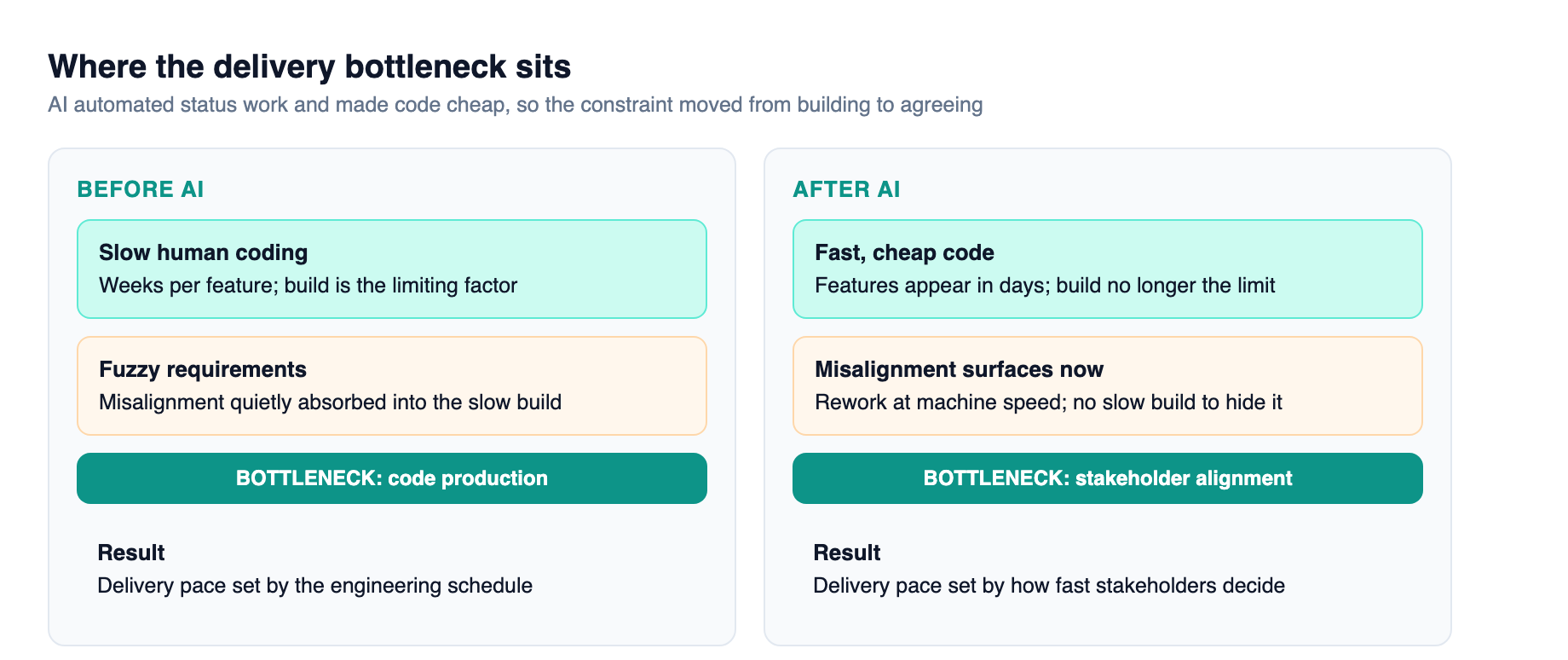
Here is the trap that catches consulting teams. When human coding was slow, a fuzzy requirement was survivable. The team had weeks to code, and the misalignment got absorbed into the build, slowly and quietly. Now the code is done in days and the misalignment surfaces immediately, as rework at machine speed. The old process absorbed ambiguity. The new one does not, so the cost of weak stakeholder alignment went from a background tax to a hard constraint.
The stakes were always there
The data has said the same thing for years, which is worth stating plainly because it reframes the argument. Stakeholder misalignment was not a new failure mode AI created; it was always the most common one. PMI has long reported that poor communications is a contributing factor in 56 percent of the projects that fail4. Aggregated project statistics put the numbers similarly: 37 percent of projects fail because stakeholders never agreed on what success looked like, and 30 percent fail because of poor communication among team members5.
The useful reading is not that these numbers are new. It is that they finally match the constraint. When the bottleneck in delivery was code production, a project could limp along on mediocre stakeholder engagement and still ship, because the engineering schedule was the limiting factor and there was slack in the human layer. The schedule is no longer the limit, and that slack is gone. Now the old failure cause is the critical path, and it can no longer be papered over by slow build times.
This is why the consultant's instinct to treat stakeholder management as important-but-soft is now actively dangerous. It was the top cause of failure all along, and the one thing that changed is that AI removed the buffer that hid it.
Decision velocity is the new constraint
If alignment is the constraint, then the metric that matters is how fast stakeholders decide. A team can generate a hundred points of work in an afternoon, but nothing ships until a human accepts it. The acceptance gate is a person reading the result, checking it against the intent, and saying yes. That gate cannot be sped up with better tooling, only with better engagement design.
The operational consequence is that decision latency becomes a first-class project metric, as important as cycle time. One useful pattern from the data: async and distributed teams are about 30 percent more likely to hit delays related to decision-making gaps when clear escalation paths are not established5. A remote consulting team with a client stakeholder who only answers in the weekly call has built a delay into every decision. The team's velocity is capped by that person's calendar.
So the project manager's job in 2026 is to design for decision speed the way the engineering lead designs for throughput. That means knowing in advance who owns each decision, how they prefer to receive information, and what the fallback is when they do not respond in time. It means treating a signed-off acceptance criterion as a deliverable with a deadline, the same way you treat a code deployment. The ceremony redesign conversation we had in our piece on sprint reviews is the same shift seen from the stakeholder side: the bottleneck is deciding, not building.
The consulting playbook
Treating stakeholder management as critical-path work changes how you run an engagement. Here is the set of practices that consulting teams actually adopt.
Make the stakeholder the oracle. In an agent-native build, acceptance criteria are the contract the agent builds against. If the criteria are vague, the agent will generate a plausible, confident version of what it thinks you meant, and the rework is on you. Before any agent picks up a story, the criteria must be testable and signed off by the person who owns the outcome. The acceptance gate is the stakeholder's job, and it has to happen before the sprint, not after the demo. The requirements piece walks through why the spec quality, not the code, is now what decides whether an increment delivers.
Design decision rights, not just a RACI. Most engagements reach for a RACI matrix and call it governance. RACI clarifies who is responsible, accountable, consulted, and informed, which is real, and it is also not enough, because it does not force a clear answer on how a decision actually gets made when people disagree6. The consulting-grade upgrade is a short decision ledger: for each recurring decision type, one named accountable decider, the inputs that decider needs, the cadence, and a decision SLA. Two business days to accept a criterion, four to resolve a scope conflict, escalate to the sponsor at the fifth. Writing the SLA down does more for delivery speed than a detailed RACI ever will, because it turns alignment from a vibe into a schedule.
Put uncertainty on the table early. Stakeholders who were trained on dates will treat a probabilistic forecast as a failure of nerve. The fix is education, and it has to start in the first week. Forecasts are ranges, delivery dates are probabilities, and surfacing uncertainty early is what lets you intervene before a miss becomes a crisis1. This is the same lesson as our estimation piece: the teams that can still promise a date are the ones that stopped pretending the number was precise. Get the sponsor comfortable with that framing before the first hard decision, or the range will read as an excuse.
Keep humans at the three judgment points. You do not need humans everywhere in an agent-native loop; that defeats the point. You need them at exactly three places: defining intent, steering tradeoffs when reality diverges from the spec, and accepting the outcome23. Everything between those points can be automated. A consulting team that over-involves stakeholders in the mechanical middle burns the very attention it needs to preserve for the judgment calls. The skill is protecting stakeholder attention, not just scheduling their meetings.
Run alignment as a cadence, not an event. Misalignment spreads fast in 2026, often through channels nobody is watching. The antidote is a rhythm: a standing decision forum, a visible ledger of open decisions and their ages, and a review that surfaces disengagement before it becomes a blocker5. If a stakeholder has not engaged with the decision ledger in a week, that is a delivery risk with a name attached, and it deserves the same urgency as a red build.
The one-line version
The bottleneck in delivery moved. It used to be code production, and AI moved it upstream to the one thing agents cannot do: getting humans to agree. Project managers did not get automated out of a job; they got promoted into the job that was always the real constraint, and the teams that will keep promising dates are the ones that run stakeholder alignment with the rigor they used to give the schedule.
Sources
-
Tommaso Maria Ricci, "AI for Project Management: The Complete 2026 Guide". tommasomariaricci.com ↩ ↩2 ↩3 ↩4 ↩5 ↩6 ↩7
-
Scrum.org, "Spec-Driven Development Isn't Waterfall Unless You're Using It That Way" (Yuval Yeret, July 13 2026). scrum.org ↩ ↩2 ↩3 ↩4
-
Yuval Yeret, "Is Spec-Driven Development a Step Forward or Back?". yuvalyeret.com ↩ ↩2 ↩3
-
Project Management Institute, "My project is failing, it is not my fault". pmi.org ↩
-
Apollo Technical, "51 Project Management Statistics To Know in 2026". apollotechnical.com ↩ ↩2 ↩3
-
McKinsey, "The limits of RACI, and a better way to make decisions". mckinsey.com ↩