

Here is the most underrated number in agentic AI this year: the same model, run through two different orchestration scaffolds, scores 64.85% on one GAIA run and 57.58% on another. Princeton's Holistic Agent Leaderboard (HAL) shows Claude Opus 4 at 64.85% inside HAL's Generalist Agent and 57.58% inside Hugging Face's Open Deep Research harness, a 7.3-point gap caused entirely by the framework layer 1. Push that comparison to its extreme (bare model versus well-engineered scaffold) and the gap reaches roughly 30 absolute points, larger than the improvement between most frontier model releases 2.
Teams still pick frameworks by GitHub stars, feature lists, or whichever vendor sent the best sales deck. The production data says that is the wrong axis. This article is the decision framework we use when a client asks which agent framework to build on: the 2026 reset, the five dimensions that predict production survival, and a one-week evaluation recipe.
The 2026 reset: the framework map was redrawn in eight months
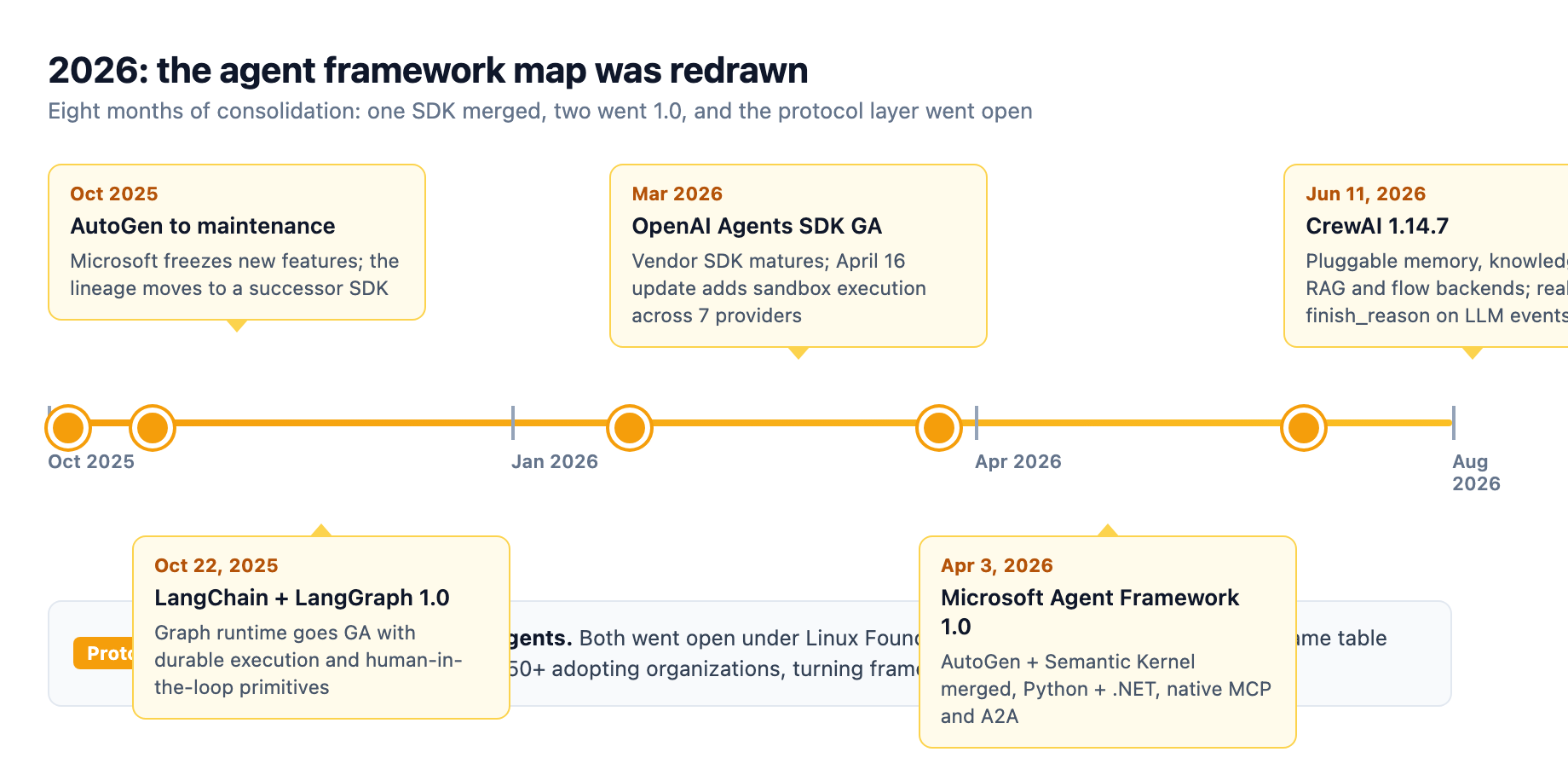
Three structural shifts between October 2025 and June 2026 changed every framework decision this year.
The frontier labs shipped first-party agent SDKs, then consolidated them. Microsoft put AutoGen into maintenance mode in October 2025 and merged it with Semantic Kernel into Microsoft Agent Framework, which reached 1.0 GA on April 3, 2026 for Python and .NET simultaneously 3. The 1.0 release merges AutoGen's orchestration patterns (sequential, concurrent, handoff, group chat, Magentic-One) with Semantic Kernel's enterprise middleware, in one SDK with native MCP and A2A support 4. LangChain and LangGraph hit 1.0 the same week (October 22, 2025), making LangGraph the production-standard graph runtime 5. AutoGen's community fork, AG2, continues at 0.12.x, but Microsoft's own lineage now lives in Agent Framework 6.
The protocols went open, and they changed the switching math. Model Context Protocol (MCP) moved to Linux Foundation stewardship with backing from Anthropic, OpenAI, Google, Microsoft, and AWS, and Agent-to-Agent (A2A) crossed 150+ adopting organizations 6. Google's design principle became the industry shorthand: MCP for tools, A2A for agents 2. The practical consequence is a real hedge against framework lock-in: a tool integration built on MCP ports between frameworks almost trivially 2.
The vendor SDKs matured into production tools. OpenAI's Agents SDK went GA in March 2026 and its April 16, 2026 update added native sandbox execution across seven providers and Codex-style filesystem tools 7. Google ADK 2.0 became the only major framework with Python, TypeScript, Java, and Go SDKs at parity. CrewAI reached 1.14.7 on June 11, 2026 with pluggable memory, knowledge, RAG, and flow backends 6. The ecosystem became a tiered market: graph runtimes, role-based crews, vendor SDKs, and a long tail of niche frameworks 2.
Why framework choice moves performance by 30 points
The framework layer is not a thin wrapper around a model. It decides how the model sees tools, how state survives across steps, how retries behave, how context gets compacted, and how much token overhead every loop iteration carries. Those mechanics show up in benchmark scores and, more importantly, in unit economics.
The CLEAR paper, a November 2025 academic framework for evaluating enterprise agents (arXiv 2511.14136), documents three findings that belong on every selection whiteboard. First, there is no cost-controlled evaluation in mainstream benchmarks, and agents achieving similar accuracy vary up to 50x in cost. Second, reliability collapses under repetition: a single-run accuracy of 60% can drop to 25% across eight consecutive runs. Third, lab scores systematically overstate production performance by an average of 37%. The paper's fix is CLEAR, a five-dimension evaluation (Cost, Latency, Efficacy, Assurance, Reliability), and its expert validation shows CLEAR predicts production success at ρ=0.83 versus 0.41 for accuracy-only evaluation 8. Optimizing for accuracy alone produced agents 4.4 to 10.8 times more expensive than cost-aware alternatives with comparable performance 8.
Independent benchmark work points the same direction. A 2026 comparison running 2,000 task instances across LangGraph, LangChain, AutoGen, and CrewAI on the same model found CrewAI carried roughly 3x the token footprint of the others on simple one-tool-call flows 2. That matters because LLM API calls run 40-60% of total agent operating cost in most production deployments; a framework that adds 40% token overhead is adding 40% on top of your single largest line item 2.
The decision: match orchestration style to task shape, then pick the framework
The 2026 frameworks stabilize around four orchestration styles. Graph-based (LangGraph, Microsoft Agent Framework) gives explicit state transitions and audit trails at the cost of ramp time. Role-based (CrewAI) maps to how stakeholders think about teams and gets a demo working in hours. Handoff-based (OpenAI Agents SDK) is minimal and opinionated. Hierarchical (Google ADK) fits parent-agent delegation and multimodal work 2. The rule that resolves most debates: match style to task shape.
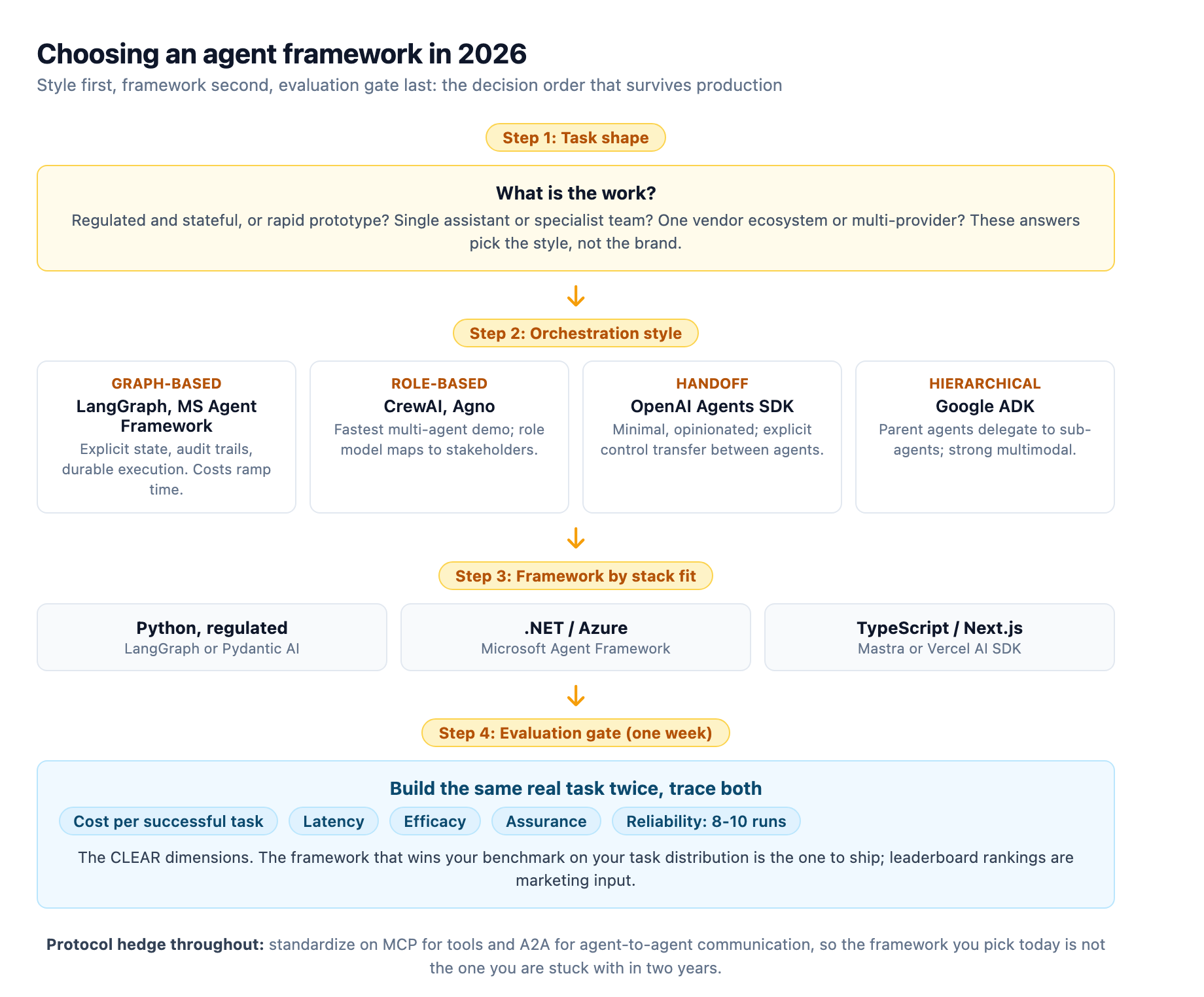
The decision matrix below captures the defaults that work for most teams shipping agentic AI today 2:
| If your situation is... | Primary choice | Strong alternative |
|---|---|---|
| Regulated industry, audit trails required | LangGraph | Microsoft Agent Framework |
| Fast multi-agent prototype in days | CrewAI | Agno |
| .NET or Azure-native stack | Microsoft Agent Framework | LangGraph (Python side) |
| GPT-centric with sandboxed tool use | OpenAI Agents SDK | Pydantic AI |
| Multimodal, GCP-native | Google ADK | LangGraph + Gemini |
| Type-safe Python production agent | Pydantic AI | LangGraph |
| TypeScript / Next.js end-to-end | Mastra | OpenAI Agents SDK (TS) |
| RAG-heavy knowledge agent | LlamaIndex | Haystack |
Three meta-principles sharpen any choice. First, optimize for switching cost: standardize on MCP for tools and A2A for cross-agent communication, because every major option except the Claude Agent SDK supports both natively or through adapters 2. Second, prefer frameworks with observability built in or natively integrated (LangSmith, Application Insights, Logfire), because tracing is what turns "the agent did something weird" from a mystery into a diff 9. Third, treat human-in-the-loop as a first-class requirement, not a bolt-on: Anthropic's 2026 agentic coding trends report calls agents that know when to ask for help the most significant architectural shift of the year 2.
How to evaluate before you commit: the one-week recipe
The CLEAR finding (a 37% average gap between lab scores and production) is why leaderboard rankings do not survive contact with real workloads 8. The fix is cheap: build the same task in your top two candidates and trace both.
- Pick one representative task from your actual workload, not a toy.
- Build it twice. Most frameworks support OpenTelemetry, so send traces from both prototypes to the same observability backend and compare side by side 9.
- Measure cost per successful task, not per run. CLEAR's cost-normalized accuracy exists because failed attempts still burn tokens 8. A cheap model with high retry rates can cost more than a reliable, pricier one.
- Run each candidate 8 to 10 times. Reliability (pass@k behavior) is the dimension that collapses in production and the one leaderboards hide. A 60% single-run agent that drops to 25% on the eighth run is not production-ready at any price 8.
- Check the protocol story. If MCP support is native rather than an adapter, you inherit new protocol capabilities as they ship and keep the option to switch frameworks later 2.
The framework that wins your benchmark on your task distribution is the one you should deploy. The one that wins a public leaderboard is a marketing input, not a decision.
Adroit on the Ground: evaluation discipline is the pattern that survives
We have been running a 10-agent delivery pipeline daily in our own shop since the spring: an orchestrator that routes work to specialist agents (architecture, design, development, accessibility, security, QA, deployment) with structured handoffs and phase gates. The pattern that keeps it alive is not the framework choice, it is the evaluation layer (our pipeline writeup). Every piece of work our content pipeline produces has to pass a mechanical verification gate before it moves forward: word-count range, no raw HTML, no bare URLs, an em-dash audit, citation alignment, and a live HEAD check on every cited URL, exiting 0 or 1 (Fortress of Solitude internal tooling, verify-article.py). That is exactly the CLEAR discipline applied to agentic output: a hard, repeatable, cost-aware check that runs before anything ships.
Two lessons transfer directly to framework selection. First, cost discipline has to be structural. We route models deliberately: cloud models for tool-calling and structured completion gates, a local llama.cpp server for free-text background work, because the cheapest model per token is not the cheapest per successful task (our hybrid stack writeup). Second, orchestration wins on parallelizable, breadth-first work and loses on tightly sequential tasks (our pipeline writeup). Framework selection is the same decision one level up: pick the style that fits the task shape, then let the framework implement it.
The honest caveat: MIT research analyzing 300-plus enterprise AI implementations reports that only about 5% of agentic projects successfully move from pilot to production, and the failure mode is almost never the framework itself, it is the absence of observability, human-in-the-loop primitives, and cost discipline built in from the first pull request 2. A framework cannot fix a missing evaluation layer; it can only give you the primitives to build one.
The framework is the lever, not the model
The 2026 framework decision has a clear shape. The landscape consolidated: AutoGen went to maintenance, Microsoft merged its two SDKs into Agent Framework 1.0, LangGraph became the graph-runtime default, and the vendor SDKs matured 4. The protocols went open, turning framework lock-in into a switching cost 2. And the data says the framework layer moves agent performance by up to 30 points on identical models, more than most model upgrades 1.
Pick the orchestration style that matches your task shape. Pick the framework that implements it best in your language and ecosystem. Then spend the week building the same task twice and tracing both, because the framework that wins your benchmark is the one you should ship, and the one that wins a leaderboard is just the one with the better press release.
Note: Fortress references describe Adroit's internal multi-agent delivery pipeline and content verification tooling (verify-article.py, model routing between cloud and local inference). Metrics quoted from external studies are as reported by the cited sources; independent verification is recommended before citing them in client materials.
- Adroit Blog: Local LLM Infrastructure in 2026 (companion) adroit-blog-two.vercel.app
- Adroit Blog: Multi-Agent Orchestration Production Lessons (companion) adroit-blog-two.vercel.app
Sources
-
Princeton HAL: GAIA Leaderboard. hal.cs.princeton.edu ↩ ↩2
-
Uvik: Agentic AI Frameworks in 2026: The Production Comparison. uvik.net ↩ ↩2 ↩3 ↩4 ↩5 ↩6 ↩7 ↩8 ↩9 ↩10 ↩11 ↩12 ↩13
-
Atlan: AutoGen Explained: Status, Architecture and Alternatives. atlan.com ↩
-
Microsoft: Microsoft Agent Framework Version 1.0. devblogs.microsoft.com ↩ ↩2
-
LangChain: LangChain and LangGraph Agent Frameworks Reach v1.0. langchain.com ↩
-
Alice Labs: Best AI Agent Frameworks 2026. alicelabs.ai ↩ ↩2 ↩3
-
Help Net Security: OpenAI Agents SDK sandbox update. helpnetsecurity.com ↩
-
Mehta et al.: Beyond Accuracy: CLEAR Framework for Enterprise Agentic AI. arxiv.org ↩ ↩2 ↩3 ↩4 ↩5
-
Langfuse: Comparing Open-Source AI Agent Frameworks. langfuse.com Further reading: ↩ ↩2