

"Digital transformation" may be the most-used phrase in enterprise tech, and one of the least useful. The 2026 reality is that ambition and delivery have never been further apart. In PwC's 2026 Digital Trends in Operations Survey, 89% of operations leaders say their technology investments have not fully delivered expected results, and only 4% report success across all four dimensions the survey tracks: AI embedded enterprise-wide, no significant barriers to scaling agents, a horizontal operating structure, and investments actually delivering. Meanwhile, global spending on digital transformation is projected to approach $4 trillion by 2027, more than two-thirds of all ICT spend, according to IDC data cited by WalkMe.
So the question in 2026 isn't whether to transform. It's what actually works, and three forces are doing the heavy lifting: AI-first process design, composable architecture, and data democratization. Each has been a slide-deck buzzword for years. This article is what they actually mean, the evidence behind them, and how to act on them this quarter.
Trend 1: AI-First Process Design
AI-first process design means the opposite of bolting AI onto existing workflows. Instead of asking "where can a chatbot save a ticket queue," you redesign the process around what an AI agent can do: sense, decide, act, and escalate, with data flowing to the right system at the right moment, and humans handling only the exceptions. It is the operational half of the enterprise-level AI strategy we spelled out separately.
The evidence that this is the dominant 2026 pattern is strong. In PwC's survey:
- 83% of leaders say AI agents and automation will accelerate the breakdown of traditional functional silos.
- 94% of companies with siloed or partially integrated operating structures expect to shift toward a more horizontal, networked model, yet only 41% operate that way today.
- 72% rank automating operations among their top-3 AI investment focuses.
- But execution lags belief: only 27% have fully embedded an AI strategy across business units, and just 37% are comfortable assigning AI agents to execute full end-to-end processes.
The gap between the 83% who believe and the 27% who've embedded it is where the real work happens. The pattern that works, based on the organizations PwC flags as leaders:
- Inventory processes and score them: rules-based decisions, high volume, and clean data inputs are the candidates for AI-first redesign. Exception-heavy, judgment-heavy work stays human-first.
- Decompose the chosen process into data flows, decision points, and exception paths. This is the step most teams skip, and the one that determines whether the agent design succeeds.
- Design the escalation layer first. Every AI-first process needs a defined handoff: when the agent's confidence drops below a threshold, the work routes to a human with full context, not a ticket that starts from zero.
- Instrument everything. The top performers in PwC's survey measure both operational and financial impact (83% of the leaders do), which means the process redesign includes metrics from day one, not after the pilot.
A concrete example of where this is already landing: health services. PwC reports 93% of health services operations leaders agree AI agents will break down functional silos, and 65% are already comfortable assigning agents to prioritize and route work across teams and systems, speeding issue resolution in claims and customer workflows. That's not a pilot; that's a production pattern.
For Salesforce-centric organizations, this maps directly onto the agent platform: your agents orchestrate across flows, data, and systems, and the process redesign work is where the value lives: defining which decisions an agent may make autonomously and which must escalate.
The pitfall to avoid: AI-first design fails at the data layer, not the agent layer. 87% of survey respondents say poor data quality has hampered progress on digital initiatives, and integration complexity is the top reason investments underdeliver (cited by 52%). An agent that routes on stale or incomplete data is just automation of bad decisions. Data hygiene is a prerequisite, not a phase-two activity.
Trend 2: Composable Architecture
Composable architecture is the anti-monolith: structuring digital capabilities as independent, interchangeable modules (CRM, CMS, analytics, payments) connected by APIs, so you can swap a component without ripping and replacing the whole estate. In practice it usually means MACH: Microservices, API-first, Cloud-native, Headless.
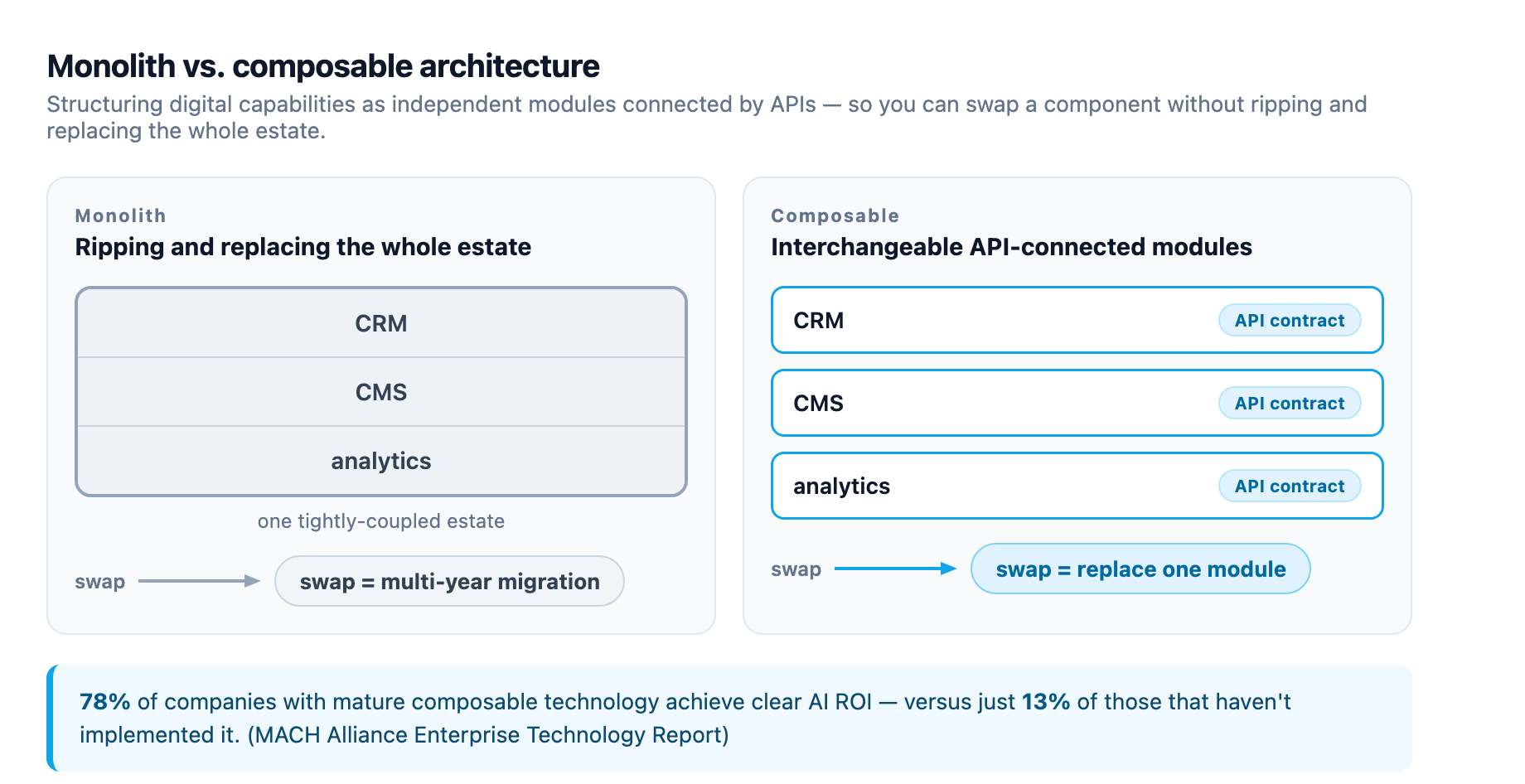
The 2026 evidence for composability is unusually concrete. The MACH Alliance Enterprise Technology Report found that 78% of companies with mature composable technology achieve clear AI ROI, versus just 13% of those that haven't implemented it, a sixfold difference. The mechanism is straightforward: AI needs clean access to data and the ability to act across systems, and composable architecture is what makes that access cheap. Gartner's projection pushes the same direction: organizations adopting composable architectures will outpace competitors by 80% in the speed of new feature delivery.
What does composability actually buy you? Three things:
- Swap-ability. When a best-of-breed component (say, a CMS or an analytics engine) stops being best-of-breed, you replace it through its API contract instead of a multi-year migration.
- Team velocity. Independent modules mean independent teams. No more release trains where a checkout change waits on the catalog team.
- AI readiness. Composable estates expose capabilities and data as services, which is exactly the surface area agents need to act. This is the direct line from MACH to the AI ROI numbers above.
The adoption path that avoids the classic trap of "composable" turning into microservices-everywhere chaos:
- Pick one bounded capability that changes frequently or underperforms (commerce checkout, content, pricing). Do not unbundle the whole estate at once.
- Define the API contract for that capability before touching the code. The contract is the product.
- Build the integration layer (an iPaaS like MuleSoft, or an API gateway) so the new module talks to the legacy core cleanly.
- Measure swap time: the metric that matters is how long a change takes to ship, not how many microservices you have.
The pitfall to avoid: composability is a delivery model, not a technology fetish. Teams that unbundle everything "because MACH" inherit distributed-systems complexity (monitoring, retries, versioning, security) without any of the benefit. The leaders in the MACH data started with one capability, proved the ROI, and scaled the pattern.
Trend 3: Data Democratization
Data democratization is the shift from "analysts query the warehouse for you" to "business users answer their own questions." In 2026 that means two things converging: self-service analytics tools with spreadsheet-like UX, and AI-assisted querying where natural language becomes the interface to data.
The market says this is mainstream: software platforms hold an estimated 72% share of the self-service analytics market in 2026, per Future Market Insights. Tools in the category, Sigma's live-query spreadsheet model, and similar governed self-serve platforms, share a critical design principle: the governance lives in the warehouse (row-level security, certified datasets, semantic layers), while the user gets a familiar interface.
The practical pattern for a data-democratized organization:
- Stand up a semantic layer. Define the business vocabulary ("revenue," "active customer," "churn") once, in the warehouse, so every dashboard and every AI query means the same thing. This is the single highest-leverage step.
- Curate certified datasets. Give business users a small set of governed, trusted tables rather than raw access to everything. Democratization without curation is just an audit finding waiting to happen.
- Choose one or two tools and train on them. Adoption comes from tool stability, not tool sprawl.
- Apply governance at the row level. Role-based access, PII masking, and data lineage are non-negotiables: they're what let you open access without opening risk.
For Salesforce-centric organizations, this is where Data Cloud earns its keep: unifying CRM data with external sources into a single customer view, then exposing that view to agents and to self-serve analytics rather than leaving it in a data team's queue.
The pitfall to avoid: the data-quality ceiling. PwC found only 30% of respondents report significant improvement in data quality and reliability, while 87% say poor data quality has hampered their progress. Democratizing bad data multiplies bad decisions faster. A governed semantic layer on top of ungoverned source data is theater. Fix the source data quality for the metrics that matter before you open the doors.
Preparing Your Organization: The Leader/Laggard Gap
The companies succeeding in 2026 treat transformation as an operating model, not a project. TEKsystems' State of Digital Transformation 2026 draws a stark line between DX leaders and laggards:
- 82% of leaders say digital transformation is a core pillar of business strategy, versus 34% of laggards.
- 76% of leaders are poised to reskill/upskill their workforce for digital tools, versus 37% of laggards.
- 72% of leaders define desired business outcomes before starting any digital initiative, versus 42% of laggards.
- 71% of all organizations plan to increase AI spending in 2026.
The pattern in that data: leaders don't have better technology; they have better sequencing. They define the outcome first, then invest in the workforce, then pick the technology. Laggards do the reverse, which is why their investments fail to land. The 4% of companies PwC identified as fully succeeding embed AI, data, and operating-model redesign together, not as three sequential projects, but as one enterprise-wide mandate.
The 2026 Action Checklist
If you take one thing from this article, take this: transformation in 2026 is three small, well-executed moves, not one big program.
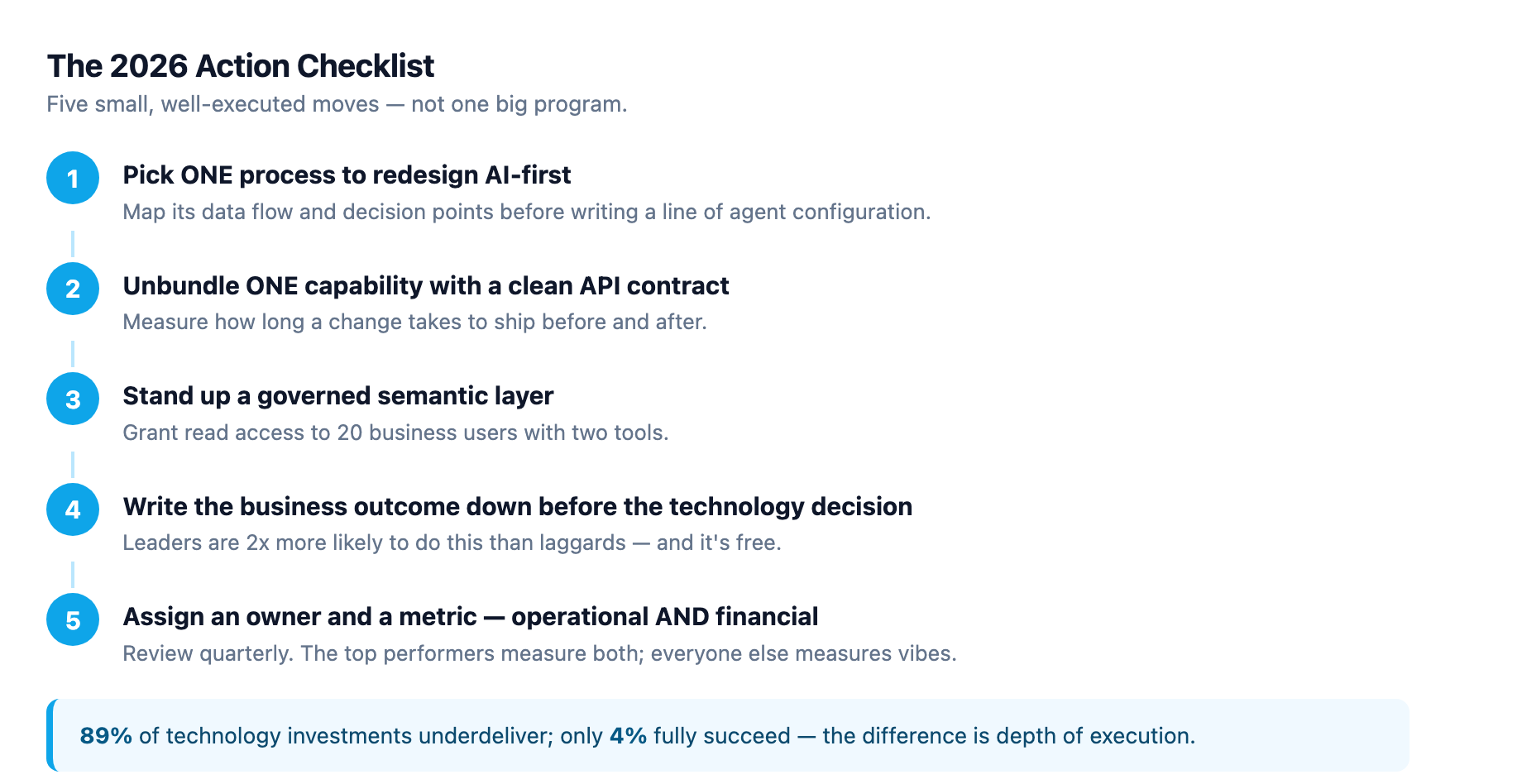
- Pick ONE process to redesign AI-first. Map its data flow and decision points before writing a line of agent configuration.
- Unbundle ONE capability with a clean API contract. Measure how long a change takes to ship before and after.
- Stand up a governed semantic layer and grant read access to 20 business users with two tools.
- Write the business outcome down before the technology decision. Leaders are 2x more likely to do this than laggards, and it's free.
- Assign an owner and a metric (operational AND financial) and review quarterly. The top performers measure both; everyone else measures vibes.
The companies still treating digital transformation as a roadmap document will keep getting the 2026 headline numbers: 89% underdelivery, 4% full success. The ones treating it as three concrete, measurable operating changes are the 6x ROI group. The difference is depth of execution, which is exactly what this article is for.
Sources
- PwC, 2026 Digital Trends in Operations Survey: pwc.com
- TEKsystems, State of Digital Transformation 2026: teksystems.com
- MACH Alliance, Enterprise Technology Report: 6X More Organizations Achieve AI ROI With a Composable Foundation: machalliance.org
- Gartner projection via Marcin Skok: Composable architectures boost speed by 80%: linkedin.com
- WalkMe, 39 Digital Transformation Statistics for 2026 (citing IDC): walkme.com
- Future Market Insights, Self-service Analytics Market report: futuremarketinsights.com
- Querio, Top Data Democratization Tools for Self-Serve Analytics in 2026: querio.ai