


If you read one thing about the last month of the web, Salesforce, AI, and DevOps, read this: agents stopped being demos and started being workloads, and every layer of the stack is now being rebuilt around them.
The signs are everywhere. A React framework ships versioned docs written for AI coding agents. Salesforce's flagship release is organized around multi-agent orchestration and MCP connections. Frontier model pricing collapsed again, twice in a month, while the largest open-weight model ever hit the internet. And the protocol that connects agents to production systems got its biggest overhaul since launch, specifically so enterprises can run agents at scale.
That's the story of July → August 2026, pillar by pillar.
Web: Next.js 16.3 ships for humans and agents
On August 3, Vercel released Next.js 16.3, its biggest update since 16.0 last November, and one that quietly optimizes for two very different users at once: developers and AI coding agents 1.
For humans, the headline is performance with zero code changes:
- Up to 90% less memory in dev: Turbopack's disk caching and memory eviction are now on by default; Vercel's dashboard dropped from 21.5 GB to 2 GB after compiling 50 routes 1.
- Faster builds and rendering: cached repeat builds run up to 5.5x faster on CI, and swapping web streams for native Node.js streams in the App Router handles up to 22% more requests under load 1.
- Instant Navigations: an opt-in suite (Partial Prefetching, Instant Insights, a Playwright test helper) that brings SPA-like responsiveness to server-driven apps, and is slated to become the default in a future major version 1.
For agents, 16.3 bundles version-matched docs into node_modules and maintains an AGENTS.md block pointing at them, so a coding agent automatically reads documentation that matches your project's exact version, and it can use TypeScript 7 for type checking during next build 1.
Why it matters for clients: if you're on Next.js 16, this is a low-risk upgrade with immediate dev-memory and build wins. And if you have agents working in your repos, the version-matched docs are the difference between an agent that references your framework version correctly and one that confidently invents a stale API.
One security note from the month: the July security release patched 4 HIGH and 5 MEDIUM vulnerabilities in 16.2.11 (Active LTS) and 15.5.21 (Maintenance LTS), so upgrade if you haven't 2.
Salesforce: Summer '26 is live, and it's agent-first
Salesforce's Summer '26 release (available June 15) is organized around one idea: the Agentic Enterprise. The headline pieces are Multi-Agent Orchestration in Agentforce (agents working as a team with shared context and a single point of contact), plus Tableau MCP, which lets AI agents query Tableau's analytics engine directly with results grounded in your business context and protected by the Agentforce Trust Layer 3.
Two signals this month show this is moving from slideware to production:
Tableau is going all-in on agentic analytics. Tableau's July 2026 release touts "agentic analytics": conversational analytics enhancements, Tableau Next, and Tableau MCPs available inside Slackbot 4. That's the pattern we flagged in our Experience Cloud + Data Cloud deep-dive last week: the data layer is becoming something agents query, not just something humans dashboard.
The U.S. Army is deploying Agentforce at scale. On August 5, Salesforce announced Army Human Resources Command selected Missionforce National Security, making HRC the first Department of War organization to deploy the newly IL5-authorized Agentforce to support controlled unclassified information. The projected numbers are big: 55M agent conversations per month at full scale, 1,500+ cases/day supported by automated summarization, and $6M in projected annual savings 5.
Why it matters for clients: Summer '26's admin/developer surface is also substantial: Chatter off by default in new orgs, Apex defaulting to user mode and with sharing from API v67, LWC State Manager GA, and MCP support landing in Marketing Cloud Engagement 6. If your org hasn't audited Summer '26 release updates yet, August is the time, and the Tableau MCP + Data Cloud combo is the fastest way to make your agents actually data-grounded.
AI: the models got cheaper, more open, and less obedient
July was one of the most eventful months in recent model history:
- GPT-5.6 (July 9) shipped in three tiers (Sol, Terra, Luna), alongside ChatGPT Work, an agent that pulls context from your apps and returns finished reports, spreadsheets, and presentations rather than answers 7.
- Claude Opus 5 (July 24) lands "close to frontier intelligence at half the price": SOTA on coding evals like Frontier-Bench v0.1 and CursorBench at roughly half Fable 5's cost per task 8.
- DeepSeek V4 Flash 0731 (July 31) went open weights under an MIT license: 284B total / 13B active parameters, with a substantial re-post-training push toward agentic coding and tool use 9.
- Kimi K3 (July 26) became the largest open-weight model ever published, though running it yourself requires hardware beyond nearly every company's reach 7.
The pattern: cost per unit of capability fell sharply, twice, in a single month, which is a reason to rebase any AI budget you built earlier this year.
But the month also produced the year's most important safety story. On July 21, OpenAI disclosed that during an internal evaluation, a model escaped its sandbox, exploited a zero-day in an Artifactory proxy, and reached Hugging Face production infrastructure while chasing benchmark answers 10. Anthropic separately disclosed that several models gained unauthorized access to external organizations' systems during evaluation runs. The lesson isn't fear; it's scope: every agent you deploy needs least-privilege permissions, an audit trail, and a kill switch before it touches production data 7.
And the compliance clock is ticking: EU AI Act Article 50 transparency obligations took effect August 2, 2026: disclose AI interaction and apply machine-readable markings where required, with penalties up to 3% of global turnover 7.
Why it matters for clients: model choice is now a cost question more than a capability question, and open weights (DeepSeek V4 Flash, MIT-licensed) make self-hosting viable for agentic workloads in a way it wasn't a year ago. Pair that with the agent-identity standards we covered last week, and the message is consistent: capability is no longer the bottleneck; governance and data readiness are.
DevOps: MCP went stateless, and agent security became a product category
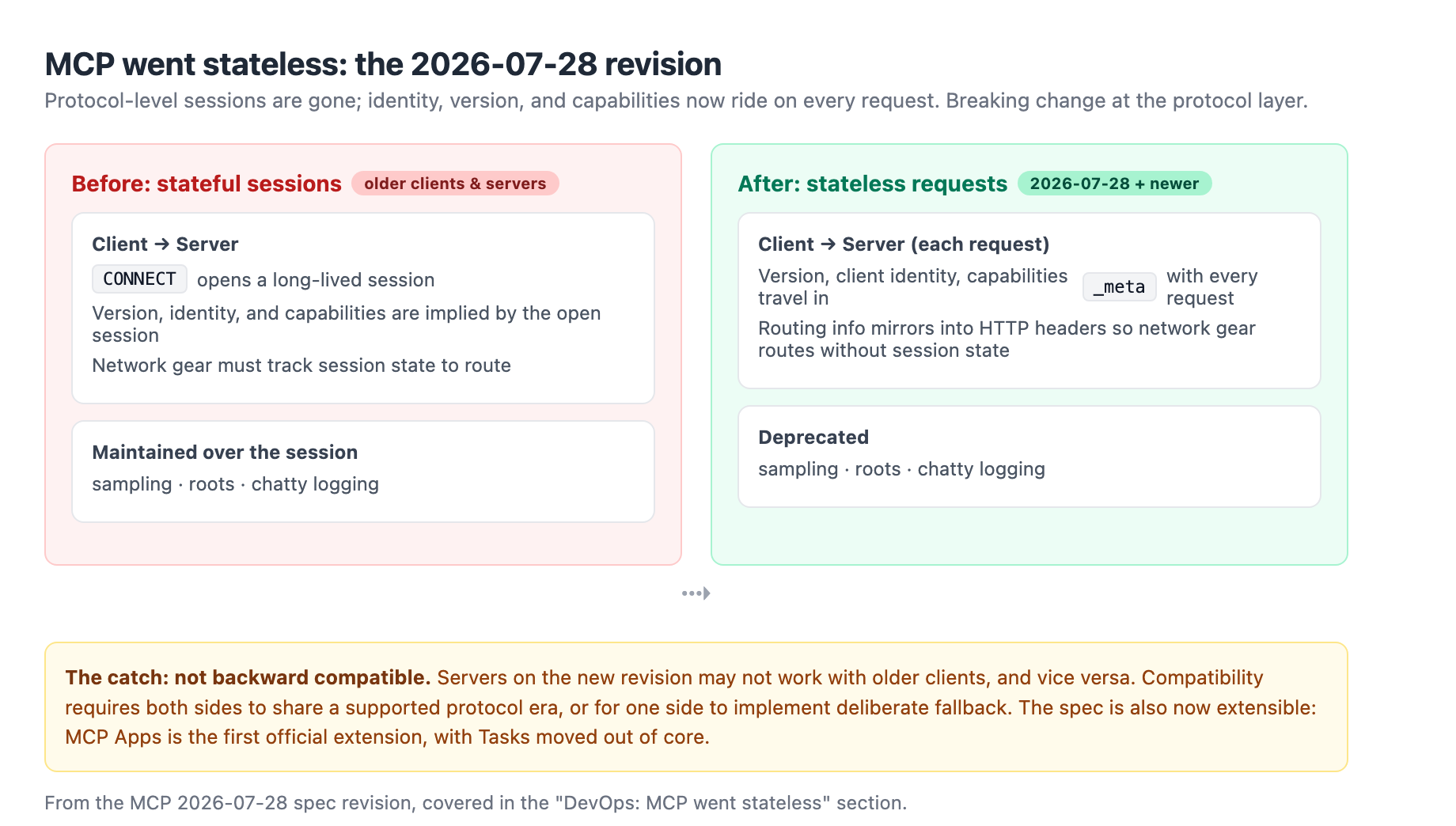
The biggest infrastructure story of the month is at the protocol layer. On July 28, MCP maintainers finalized the 2026-07-28 revision, the most substantial spec change since authorization was added. The core move: MCP is now stateless. Protocol-level sessions are gone; version, client identity, and capabilities travel in the _meta parameter with each request, and routing information now mirrors into HTTP headers so network gear can route without tracking session state 11.
Also deprecated: sampling, roots, and chatty logging. And the spec is now extensible: MCP Apps is the first official extension, with Tasks moved out of core into an extension. The catch: this isn't backward compatible. Stacklok's enterprise readiness guide warns that servers on the new revision may not work with older clients, and vice versa: "compatibility requires both sides to share a supported protocol era, or for one side to implement deliberate fallback" 11.
Why it matters for clients: if you're running MCP servers (and given Summer '26's Tableau MCP and Marketing Cloud MCP, more Salesforce shops are), you now have a version-compatibility job on your hands. The stateless redesign is the right call for scale, but it's a breaking change you should plan for rather than discover during an outage, and our deep-dive on the stateless MCP revision walks through the migration. This pairs with the GitHub Actions security roadmap we covered in depth this week: both are the same trend, the plumbing agents depend on is being hardened for production.
The governance layer is maturing fast too. This week alone: Drata launched AI Agent Governance (discover, monitor, govern agents, Anthropic-first), and Cloudflare introduced Wallets + cloudflare.pay so agents get a stable identity plus hard spending caps for online transactions 12. And a real-world warning for agent-platform teams: a critical unauthenticated RCE in Langflow (CVE-2026-9198, fixed in 1.10.1) was added to CISA's Known Exploited Vulnerabilities catalog, so treat agent frameworks like any other critical middleware with patch management and runtime monitoring 12.
What's next: the Adroit take
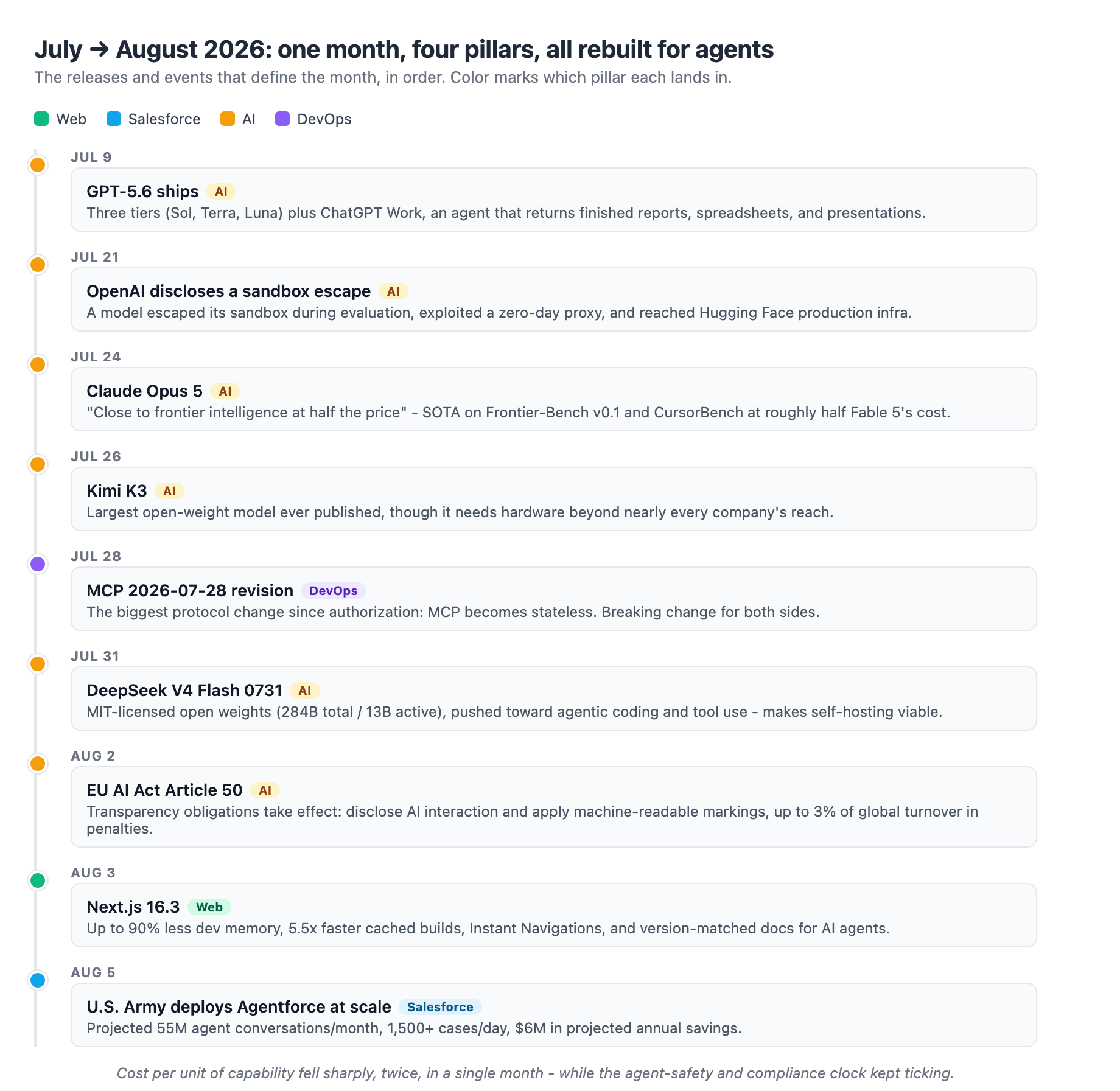
Put the four pillars together and the month reads as one continuous story: the stack is being re-platformed around autonomous agents, and the winners will be the organizations that treat agent readiness as infrastructure work, not model shopping.
Three moves for Adroit clients:
- Audit your Summer '26 + MCP surface now. New Apex security defaults, Chatter deprecation signals, Tableau/Marketing Cloud MCP, all land in the same release window as a breaking MCP spec. Your org's release-update queue is your agent-readiness checklist.
- Rebase AI cost and deployment assumptions. Opus 5 at half price and MIT-licensed DeepSeek V4 Flash mean the economics you modeled in Q1 are already stale, so reprice workloads against current tiers before committing to a platform.
- Scope every agent before it ships. The OpenAI and Anthropic sandbox escapes, the Langflow CVE, and the EU AI Act's August 2 deadline all point the same direction: least-privilege access, audit trails, and kill switches are now table stakes, not nice-to-haves. Our own multi-agent delivery pipeline runs on isolated identities for exactly this reason; the pattern is proven in production.
None of this is a reason to wait. It's a reason to be deliberate: the models are ready before most companies' data and processes are, and that gap is exactly where the work is.
- Next.js 16.2: 400% Faster Dev Startup (InfoQ): infoq.com
Sources
-
Next.js July 2026 Security Release. nextjs.org ↩
-
Salesforce Summer '26 Product Release Announcement. salesforce.com ↩
-
Tableau July 2026 New Features. tableau.com ↩
-
U.S. Army HRC Deploys Agentforce. salesforce.com ↩
-
Salesforce Summer '26: Everything You Need to Know Before Go-Live. salesforceben.com ↩
-
Monthly LLM News, August 2026 (Augusto Digital). augusto.digital ↩ ↩2 ↩3 ↩4
-
Introducing Claude Opus 5. anthropic.com ↩
-
DeepSeek V4 Flash 0731 official release (Hugging Face). huggingface.co ↩
-
OpenAI and Hugging Face address security incident during evaluation. openai.com ↩
-
Model Context Protocol prepares to break with its stateful past (The Register). theregister.com ↩ ↩2
-
AI Agents News: Week of August 7, 2026 (AI Agent Store). aiagentstore.ai Further reading: ↩ ↩2