


Three years ago, an article like this one would have spent its opening defending server components. That debate is over. In 2026 the questions are where to draw the client boundary, how each route should render, and how to keep the parts that must run in the browser small enough to matter.
The current state of play, verified against the npm registry on August 7, 2026: React is at 19.2.8, Next.js at 16.3.0 (released August 3, 2026), and Zustand at 5.0.14. 1 The previous version of this article predicted Next.js 16 as the future. It was right, and the 16.x story matters because it runs against the grain: dynamic by default, with no hidden or implicit caching. 2 The 16.3 release, with its Instant Navigations, gets its own focused treatment in our Next.js 16.3 walkthrough.
What follows are the five decisions that shape a scalable React architecture in 2026, plus the failure modes that undo them.
The client boundary is the architecture
The most consequential decision in a 2026 React app is not which library you pick. It is which files carry the "use client" directive. In the App Router, layouts and pages are Server Components by default. "use client" marks a boundary: that file, and everything it imports, ships to the browser as JavaScript. 3
The 2025 Web Almanac put the median home page at 2.86 MB on desktop and 2.56 MB on mobile, with JavaScript the second-largest contributor at 697 KB and 632 KB respectively. 4 JavaScript is the most expensive of those bytes: a kilobyte of image data is pixels, a kilobyte of script is parse time, compile time, and main-thread execution on every load. 4
The framework's decision rule is short. Client Components for state, event handlers, lifecycle effects, and browser-only APIs. Server Components for data fetching close to the source, for secrets that must never reach the client, and for shrinking the shipped JavaScript. 3
Picture a product listing page. The page is a server component that queries the database directly and renders the grid; only the search box and add-to-cart are client components, fed by props. The browsing experience ships no data-fetching code to the browser.
Applying this means treating the directive as a review gate. Keep client components shallow and toward the leaves of the tree. When a client component needs server-rendered content around it, pass it as children; it stays in the server tree. Mark server-only modules with the server-only package so an accidental client import fails at build time instead of leaking a secret. 3
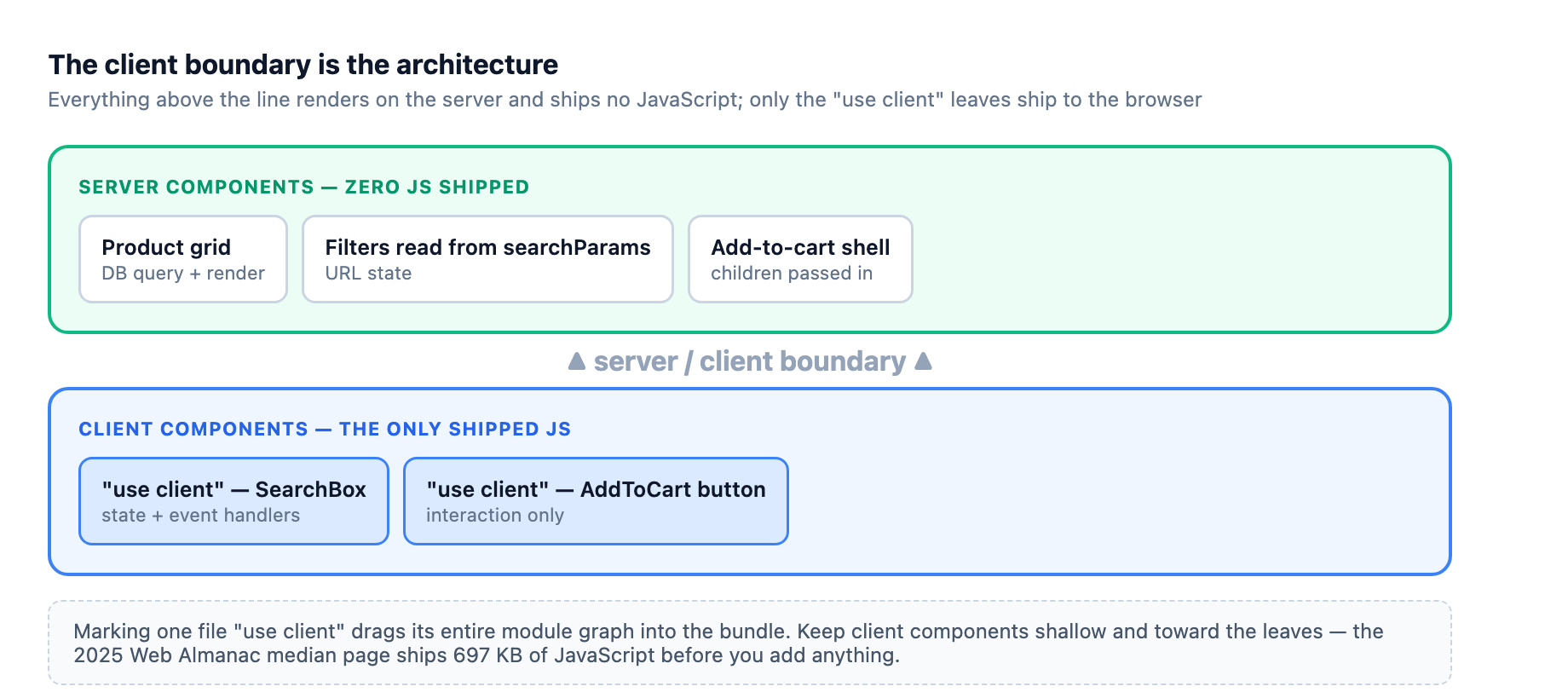
The pitfall that bites hardest is boundary creep: mark a file "use client" and its entire module graph joins the bundle, so one directive at the top of a shared component drags charts, date pickers, and utility code into every route. The second is environment poisoning: importing a module that reads process.env from a client file, where non-NEXT_PUBLIC variables silently become empty strings. Both stay invisible until you profile. 3
Rendering strategy is per route, not per app
The legacy version of this article told you to reach for edge rendering whenever content was dynamic. The real 2026 model is finer-grained. Next.js 16 is moving to dynamic by default, with no hidden or implicit caching, and 16.3 ships Instant Navigations to make that model feel like a single-page app. 2 A route is static unless something marks it dynamic: reading cookies(), headers(), searchParams, or params does. To opt in explicitly, await connection(). 5
The trade-off is latency against personalization: static pages serve from a CDN with Time to First Byte in the tens of milliseconds, request-time rendering in the hundreds (30-100 ms vs 150-600 ms in one 2026 comparison). 6 The gap is the price of personalization, because static generation cannot produce a page that differs per user. 6
Take an e-commerce store: marketing pages and product pages for a stable catalog are static or ISR with a revalidation window. The cart, the account page, and the recommendations rail are dynamic, rendered at request time and streamed through Suspense so the static shell paints first. When a personalized route needs to run close to the user, the edge runtime is where that happens: request-time rendering with latency kept near the user. 6
Apply it per route, and contain dynamic access inside Suspense. A page that reads a theme cookie for one widget should not surrender its whole route to dynamic rendering; wrap that widget in Suspense and the rest of the page stays in the static shell. Next.js 16.3 also improved ISR: URLs not prerendered at build time serve an instant loading shell to the first visitor while the real page resolves. 2
Two pitfalls dominate. The first is a cookies() call at the top of a page component, silently converting an entire route to dynamic rendering and killing cacheability you never meant to lose. The second is using Suspense as a hiding place: a fallback makes the page paint faster but does not make the query faster, and crawlers skip the shell and wait for the full dynamic render, so anything the shell depends on must also work at request time. 5
Data fetching happens in render, and caching is explicit
The App Router moved data fetching into the component tree. An async server component awaits a query and renders the result; the framework streams it. On the client, React 19's use() reads a promise and suspends until it resolves, the bridge for streaming data from a server component into an interactive subtree. 7
The rules around use() matter more than the API. The promise you pass must be cached so the same instance is reused across re-renders; otherwise React warns about an uncached promise. You cannot wrap use() in try-catch; errors belong in an error boundary. And a promise crossing from server to client must resolve to a serializable value. 7
A dashboard is the canonical example. The old pattern fetched user, orders, and recommendations in three sequential client effects, a waterfall of round trips. The 2026 pattern is a server component that starts all three queries in parallel and awaits them together. That parallelism is the structural benefit of server-side fetching, and it never happens by default. If a parent awaits one query before rendering a child that fetches its own, you have rebuilt the waterfall on the server. 8
Caching is now explicit by design. Fetch is not cached by default anymore; you choose. React's cache() deduplicates identical calls within a render pass, and it is server-only, so scope it per request rather than per module to avoid leaking data between users. 9 For longer-lived caching, Next.js 16 offers the "use cache" directive with cacheLife for time-based freshness, and the default store is per-instance, so a shared remote store earns its round trip only at high hit rates. 5 For interactive refetching and optimistic updates on the client, a data layer like TanStack Query or SWR remains the right tool. 10
The production review pattern is short: sequential awaits in components that could fetch in parallel, uncached promises passed to use(), try-catch around use(), and whole pages blocked on one query when Suspense could stream the rest.
State management is now a small slice of the app
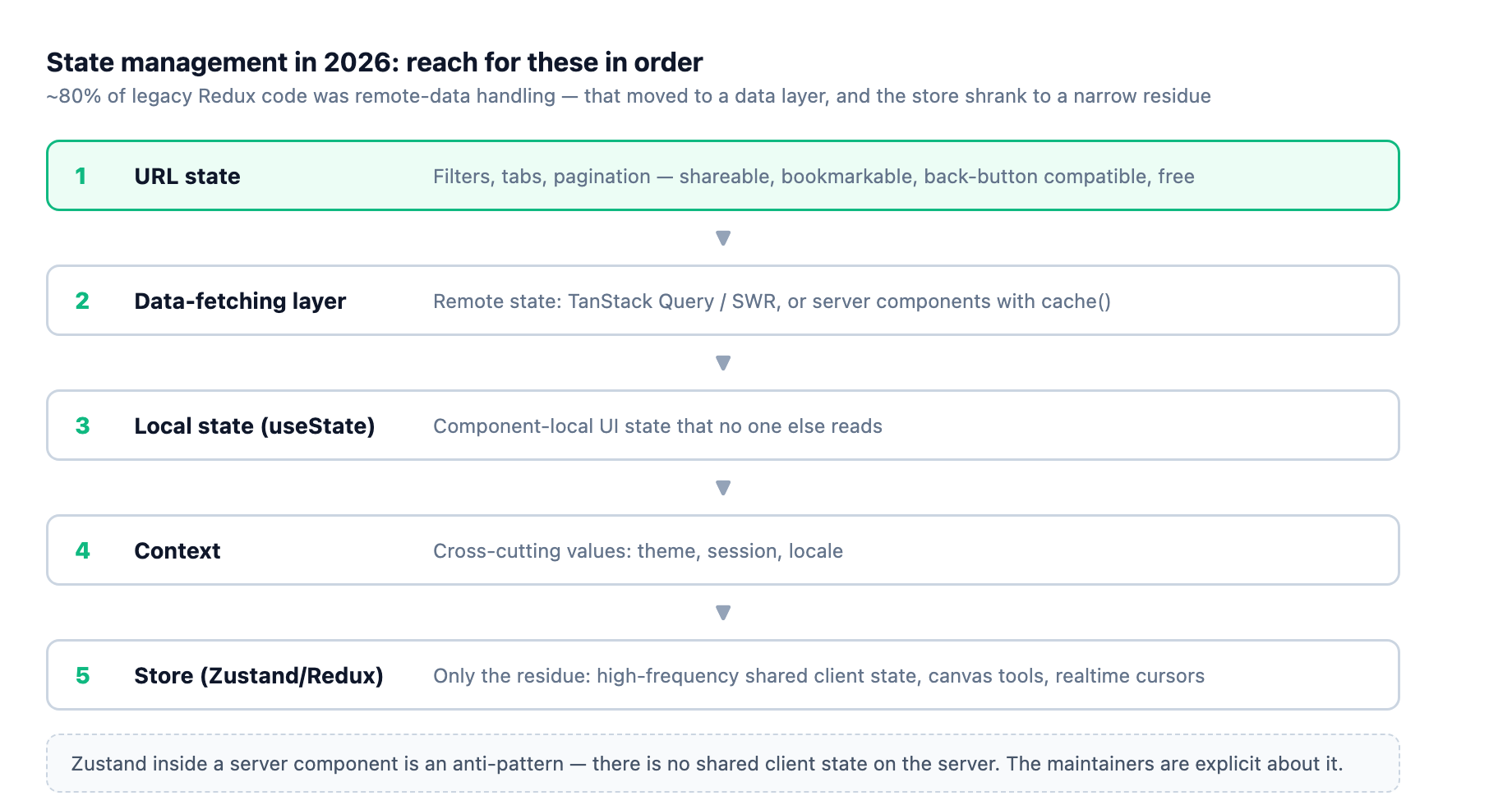
State management shrank because most state changed homes. The developerway analysis of what a modern app actually manages is the closest thing to consensus: remote state belongs in a data-fetching layer, URL state belongs in the URL, local state stays in useState, shared state starts with context, and only the residue needs a store. Roughly 80% of the code in a legacy Redux app is remote-data handling, and moving that to a data layer removes around 90% of your state management problems. 10
URL state is the most underrated piece. Filters, tabs, pagination, and onboarding steps are state, and the URL is where they belong: shareable, bookmarkable, back-button compatible, free. 11 The product grid is the classic case: read filters from searchParams in a server component, filter on the server, and update the URL when the user changes one. No store exists in that flow, and the page deep-links, survives refresh, and renders on the server.
Stores still earn their keep in a narrow band: genuinely shared client state with high write frequency across unrelated components, like canvas tools, realtime collaboration cursors, and offline queues. Zustand 5.x is the light default for that slice, and it stays on the client. The maintainers are blunt that a store inside server components is an anti-pattern, because there is no shared client state on the server. 12 Redux Toolkit stays justified where you want mature devtools and a disciplined action history across a large client-heavy surface.
Apply it in this order: URL state first, then local state, then context for cross-cutting values like theme and session, then a store only for the residue. 10 The pitfall is cargo-culting the old default: server data in a client store, URL state duplicated into memory, or a store bolted onto a codebase whose only shared state is one theme toggle.
Route-level performance and the compiler
Route-level code splitting is table stakes: the App Router splits per route automatically and Turbopack is the default bundler. 13 The remaining wins are deliberate: heavy interactive modules like charts, editors, and maps should be dynamic imports so the route shell never pays for them, and 16.3's partial prefetching and prefetch inlining control what a link pulls in before a click. 2
The bigger change is that manual memoization is mostly obsolete. React Compiler 1.0 went stable in October 2025 and is listed as stable in Next.js 16. 14 The production numbers are the reason to turn it on. Meta reports up to 12% faster initial loads and more than 2.5x faster interactions in the Quest Store. Sanity precompiled 1,231 of 1,411 components and cut render time and latency by 20-30%. Wakelet measured LCP improving from 2.6s to 2.4s and INP from 275ms to 240ms after rolling it to 100% of users. 14
Not everything is free. Independent testing on a 15,000-line app found initial-load gains negligible while interaction wins varied by component, and some libraries, react-hook-form among them, have reported compatibility issues under the compiler. 14
The practical sequence: run a bundle analysis, set a JavaScript budget for the initial route, dynamic-import everything gated behind interaction, enable the compiler, and verify INP on the interactions that stay client-side. The pitfall is doing too much at once: lazy-loading a component that renders on every load, sprinkling useMemo where the compiler already covers it, or letting one third-party client leaf drag its dependency tree into the route chunk.
The failure modes that bite at scale
Most scaling problems are unoriginal. They are the same four failures at larger sizes. Over-eager client components, where one directive poisons a subtree and the bundle grows silently. Waterfall fetching, in the browser or on the server, where each request waits on the previous one. Bundle bloat without a budget, on a trend line that keeps growing. And implicit dynamic routes, where a cookies() read kills caching on a page nobody intended to be dynamic.
Each has a cheap guard. Review every "use client" file at the same bar as an API boundary. 8 Start independent fetches in parallel inside server components. Budget JavaScript per route and fail the build over it. Audit route segments for dynamic access before adding caching back.
The architecture that scales in 2026 is not exotic. Server components carry rendering and data access. Each route picks static, dynamic, or ISR on its own terms, with caching made explicit. State lives in the URL and the data layer first, and stores serve the narrow slice of genuinely shared client state. The compiler handles memoization, and the bundle has a budget. None of this is new. The platform finally defaults to it, and the frameworks stopped pretending otherwise.
Sources
-
react@19.2.8, next@16.3.0, zustand@5.0.14 (npm registry version checks, August 7, 2026). registry.npmjs.org ↩
-
Next.js 16.3. nextjs.org ↩ ↩2 ↩3 ↩4
-
Server and Client Components: Next.js Docs. nextjs.org ↩ ↩2 ↩3 ↩4
-
Page Weight: The 2025 Web Almanac, HTTP Archive. almanac.httparchive.org ↩ ↩2
-
Caching: Next.js Docs. nextjs.org ↩ ↩2 ↩3
-
SSG vs SSR: Which Approach Will Dominate Web Development in 2026?: BCMS. thebcms.com ↩ ↩2 ↩3
-
React Server Components in Production: Benefits, Pitfalls and Best Practices for 2026: Growin. growin.com ↩ ↩2
-
React 19 use() Hook: Data Fetching Patterns That Actually Work: SitePoint. sitepoint.com ↩
-
React State Management in 2025: What You Actually Need: Developer Way. developerway.com ↩ ↩2 ↩3
-
React State Management 2026: Zustand vs Redux vs Jotai: nextfuture.io. nextfuture.io.vn ↩
-
Using Zustand in React Server Components: pmndrs/zustand Discussions. github.com ↩
-
nextjs.org. nextjs.org ↩
-
Meta's React Compiler 1.0 Brings Automatic Memoization to Production: InfoQ. infoq.com ↩ ↩2 ↩3