


The failure is in the order of operations
Most Data 360 projects do not fail on the connector. They fail on the sequence. Teams license the platform, connect every source they can reach, load ten years of history "just in case," and then spend months untangling match rules and credit bills. The pattern that ships is narrower: one or two outcomes, a canonical model defined before ingestion, conservative identity rules, and an activation path that reaches a real workflow.
Data 360 is Salesforce's customer data platform, rebranded from Data Cloud. Its four jobs: unify data into a common model, resolve identity across systems, keep profiles fresh, and activate where work happens1. It is not a data lake replacement, not a reporting tool, and not a plug-and-play personalization feature. Long-term storage and large-scale historical analysis belong in a warehouse; dashboards belong in Tableau or CRM Analytics; identity design, modeling, governance, and activation require deliberate architectural decisions1.
Why the sequence matters: grounding. Salesforce's architect guide positions Data 360 as the operational backbone of the agentic enterprise, because agents are only as trustworthy as the context they retrieve, and Data 360 is where that context gets unified and governed2. This builds on our Experience Cloud personalization playbook and our Agentforce production patterns guide; this is the data layer both assume.
Pattern 1: Outcomes before ingestion
The first implementation pattern is to define use cases before data streams. Salesforce's own learning path treats readiness, connection steps, and unification concepts as core building blocks that must come before segmentation; projects fail when teams skip the foundations and jump straight to activation3.
The practical shape is a phased roadmap with named durations. Discovery and use case definition runs one to two weeks. Data inventory and source mapping runs two to three weeks and produces a map of where customer data lives, ranked by trust. Identity resolution strategy runs two to four weeks. Data ingestion and modeling runs two to four weeks. Activation runs one to two weeks. Testing and validation runs two to three weeks. Rollout and governance never ends4.
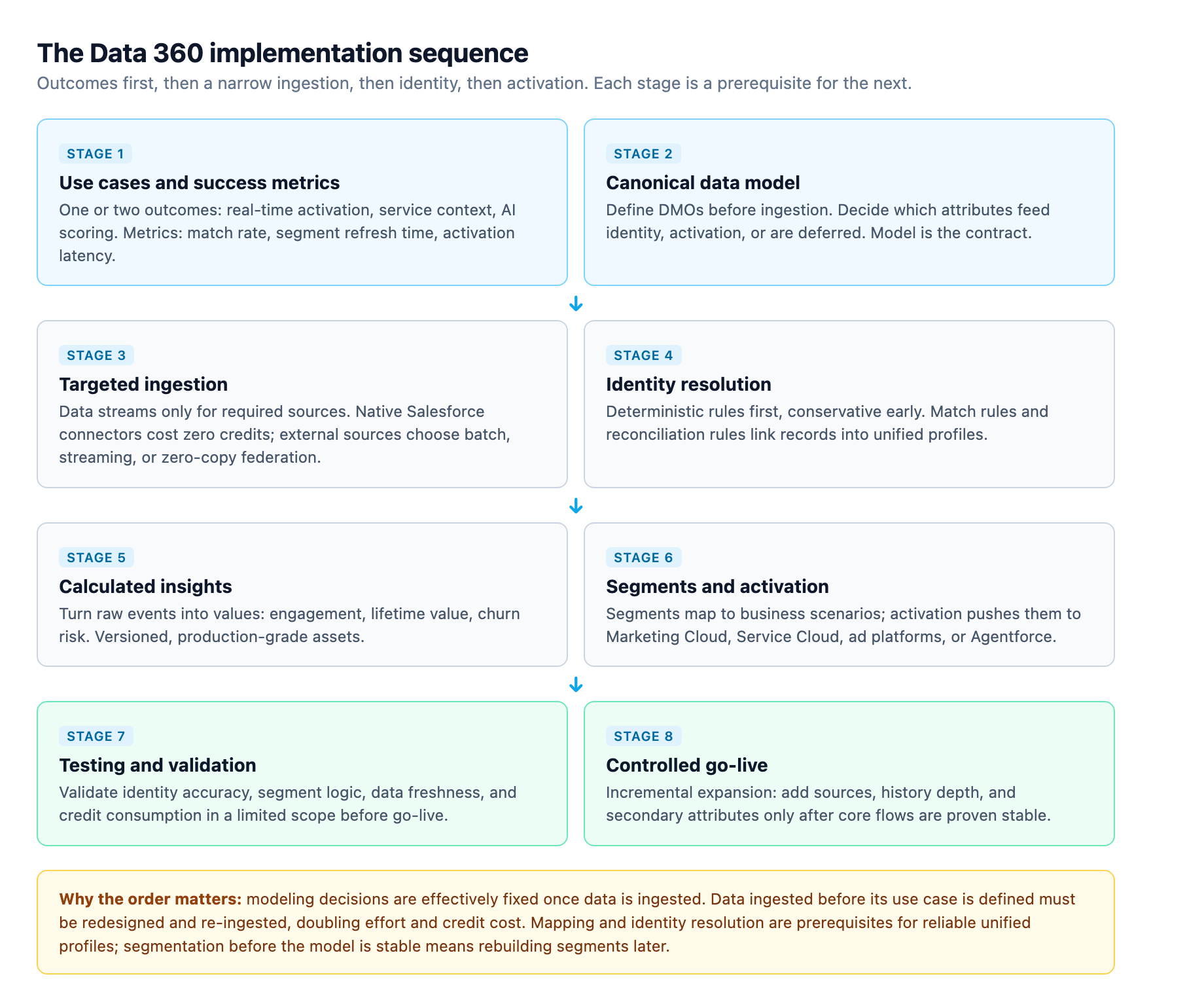
The timeline depends on scope. Simple single-source pilots run four to eight weeks; enterprise rollouts spanning multiple Salesforce Clouds, external warehouses, and identity resolution at scale run three to six months4. The success metric keeps teams honest: Noltic ties every use case to explicit measures such as identity match rate, segment refresh time, activation latency, or service efficiency, then maps dependencies backward1.
The pitfall here is treating Data 360 as a place to "load everything first and decide later." That mindset comes from data lakes, and it works poorly here. Once data is ingested, it is modeled into categories, profile, engagement, or other, and those decisions are effectively fixed; data modeled wrong can only be fixed by redesigning and re-ingesting, doubling effort and cost1. Keep the initial scope narrow. Historical data and edge-case attributes get deferred until core flows are stable1.
Pattern 2: The DLO-to-DMO mapping is the critical path
Data lands in Data Lake Objects (DLOs) in its original format, field names and types unchanged, a safe holding area that preserves source integrity. Teams then map fields into Data Model Objects (DMOs), the canonical structure where email, phone, and transaction data follow one shared shape regardless of origin1. The Customer 360 Semantic Data Model provides the canonical objects, Individual, Account, Order, Engagement, and the mapping phase decides which source is the master for each field: CRM on lifecycle stage, product analytics on usage, enrichment on firmographics4.
The mapping is a prerequisite for everything downstream. Identity resolution only works when the required mappings exist for customer information streams; Trailhead walks through mapping the Individual ID field before any unification can happen3. Segmentation depends on the ingested and mapped model and its relationships, so building segments before the model is stable means rebuilding them later3. Treat the canonical model as the contract: which DMOs exist, what each represents, and which attributes are in scope for the first implementation1.
The trap is that mapping decisions look reversible and are not. A field mapped to the wrong category at stream creation stays wrong until someone re-ingests. Document modeling intent before ingestion, and resist the "add every field just in case" reflex: every field is a cost decision1.
Pattern 3: Identity resolution, done conservatively
Identity resolution is where Data 360 turns multi-source records into unified profiles, and it is the easiest place to go wrong fast. Two matching approaches exist. Deterministic matching links records through defined comparison logic on identifiers, with exact, normalized, and fuzzy precision levels; it is accurate, easy to audit, and low risk of false matches5. Probabilistic matching evaluates attributes together, name, address, device information, and assigns a confidence score, linking records only when the score clears a threshold5. Start deterministic and add probabilistic only where exact identifiers are missing5.
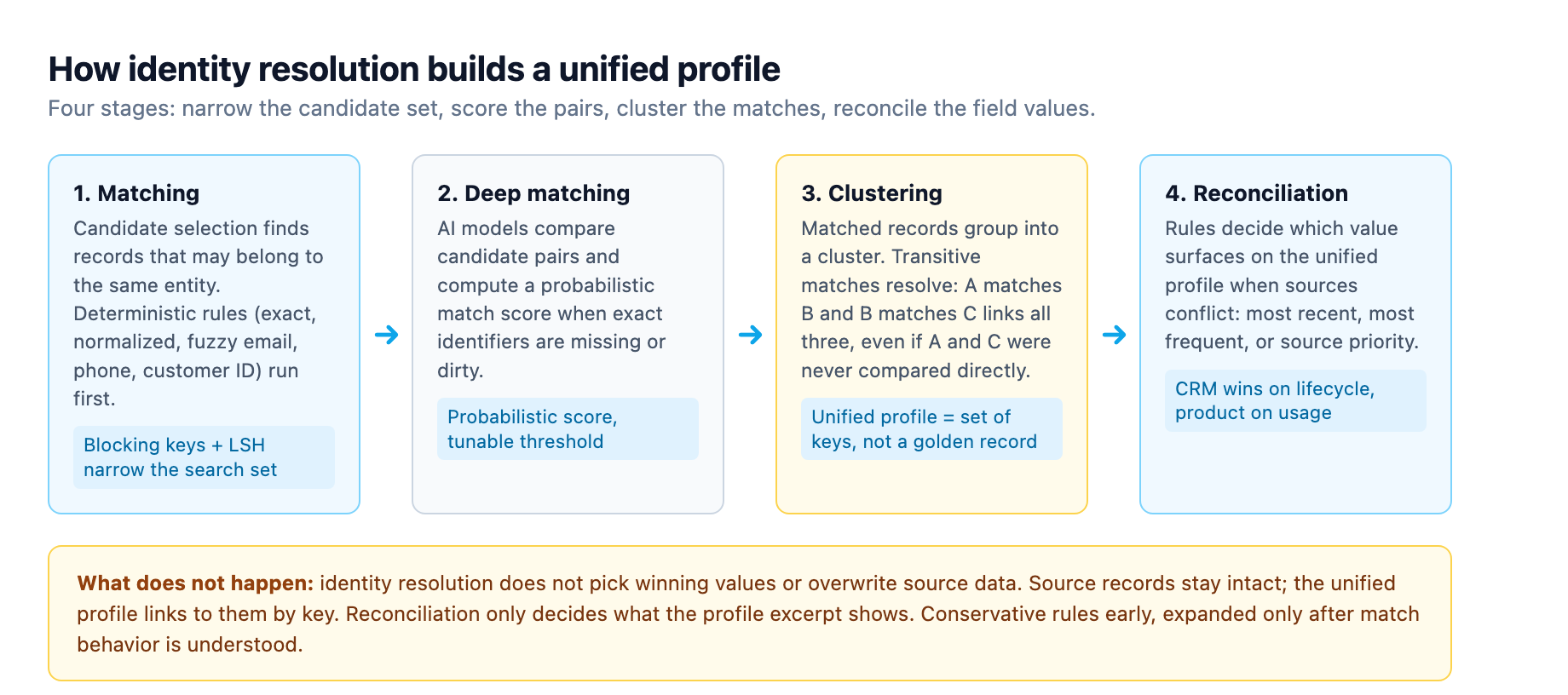
Under the hood the pipeline has four stages2. Matching, also called candidate selection, uses blocking keys and locality sensitive hashing to compare only small candidate groups instead of the whole dataset. Deep matching then analyzes each candidate pair with AI models and computes a probabilistic match score. Clustering groups matched records and resolves transitive matches, so if record A matches B and B matches C, all three link even if A and C were never directly compared. Reconciliation evaluates values from all clustered records using rules such as most frequent, most recent, or source priority to populate the unified profile2.
The mental model that prevents the worst mistakes: a unified profile is not a golden record. Identity resolution does not pick winning values or override source data. The unified profile is a set of keys that unlock source data by identifying every matching record, and reconciliation only decides what the profile excerpt shows2. Source records stay intact and queryable.
The discipline that ships: keep identity rules conservative early and expand them only after data quality and match behavior are well understood1. Configure match rules strictly for the initial activation scenarios, separate known and anonymous identity flows where applicable, and validate unified profiles against known test cases and edge cases rather than synthetic samples1. Audit the identity graph, which shows which identifiers caused which links, whenever a merge looks wrong5.
Pattern 4: Credit-aware ingestion
Data 360 runs on consumption-based credits, and ingestion, processing, segmentation, and activation all consume them1. The cost model deserves planning before any stream is created: the biggest bill line is processing, not storage.
Two facts anchor the budget. Identity resolution is the largest single drain, roughly 100,000 credits per million rows processed4. And the most common cost overrun trigger is bulk-loading every historical record because "we might need it," which sends dirty records through identity resolution, drains credits, and rarely feeds an active use case4. Ingest only what the defined use cases need, filter irrelevant records upstream, and treat every field as a cost decision1.
The ingestion approach itself is a credit lever. Native Salesforce connectors for Sales, Service, Marketing, and Commerce Cloud ingest at zero credits4. For external systems, the decision is batch, streaming, or zero-copy federation. Federation against Snowflake, Databricks, BigQuery, or Redshift avoids duplication and lets Data 360 query data in place, but adds latency; streaming is faster and burns more credits4. Rule of thumb: if data must be canonical, governed, and used everywhere, ingest it; if it is large, less frequently used, or best kept in the warehouse, federate it; most enterprises end up hybrid3.
For reference, third-party pricing estimates put Flex Credits at $500 per 100,000, a Starter SKU around $60,000 a year list, and storage at $23 per month per terabyte4. Those numbers shift, so model your own volume before committing. Monitor consumption through the Digital Wallet, validate credit impact in sandboxes before production, and treat consumption as an architectural constraint, not an afterthought1.
Pattern 5: Activation, or it is an expensive data lake
Unified profiles sitting in Data 360 do not book meetings, route leads, or update reps. If the implementation stops at data unification, the ROI never shows up4. The fifth pattern: pick one activation path tied to a measurable outcome and build the data model backward from it.
Activation has real destinations. Segments push to Marketing Cloud for journeys, surface in Service Cloud for context-aware case handling, drive personalization in Commerce Cloud, and reach ad platforms like Google Ads, Meta, or TikTok1. Inside Salesforce, activation also means data actions that react to changes, sending events to Platform Event, Marketing Cloud, or webhooks, and exposing profile data and Calculated Insights to Agentforce agents at activation time34. This is the layer that makes the platform worth its credits.
The case for doing it in order comes from a published enterprise example. Noltic's global B2C retailer, spanning CRM, e-commerce, mobile app, and paid media, saw impact within weeks of a staged rollout: identity match rate climbed from 20% to 85%, segment refresh dropped from 72 hours to under 20 minutes, campaign click-through rose 25%, and integration and maintenance costs fell 30%1.
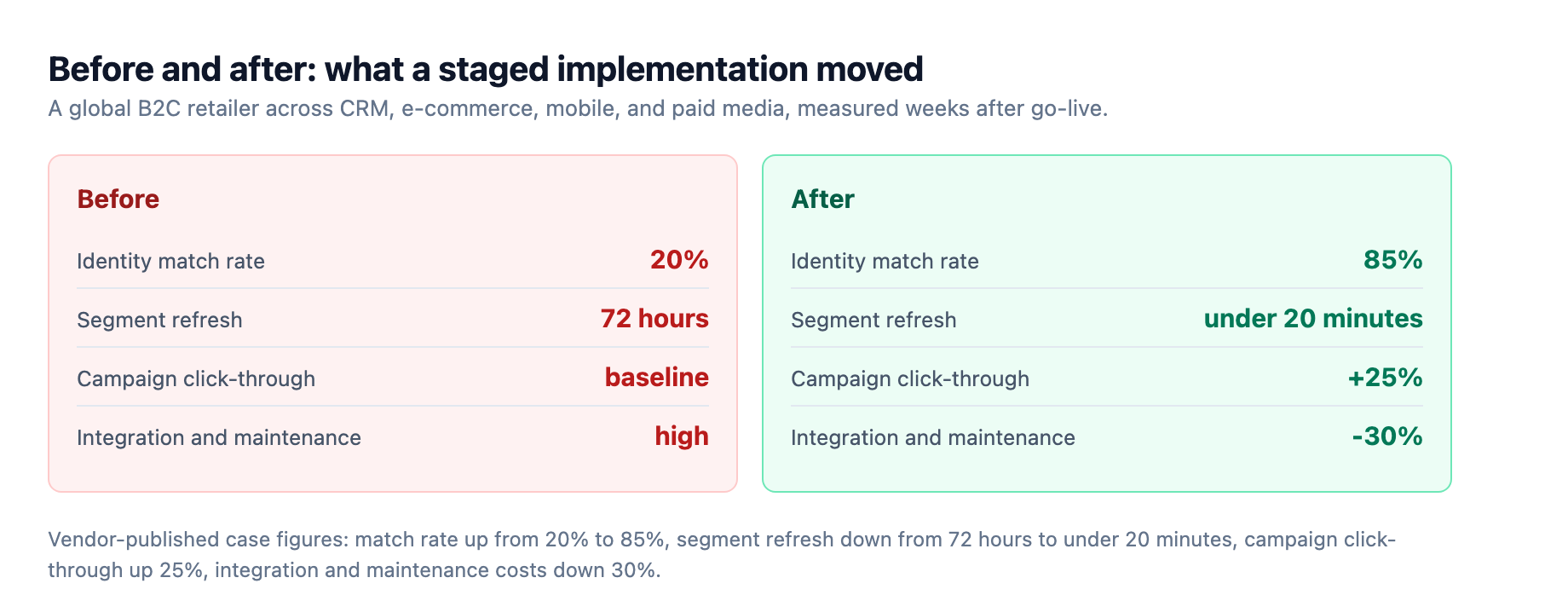
Vendor-published numbers, so treat the figures as directional. The mechanism behind them is the pattern: known and anonymous identity flows unified, segments that refresh close to real time, activation measured against success metrics. Start with one activation path, validate segment accuracy against expected profile counts, measure activation latency, and expand destinations only after the first one holds1.
Governance is the pattern that never ends
Data 360 consolidates sensitive customer data from multiple systems, so consent, privacy, and access controls have to be defined before ingestion, not retrofitted after activation starts1. The platform gives you the machinery: attribute-based access control enforced through CEDAR policies, with field-level security, row-level security, and dynamic data masking applied at the point of access without altering the underlying data2. Those policies hold whether data is queried directly, retrieved for RAG, or surfaced in Salesforce related lists2.
The operational side is where implementations decay. An instance not maintained over a quarter loses half its value: field mappings break when sources change, identity rules degrade as new sources land, and credit consumption climbs because nobody is watching4. Establish naming conventions, data ownership, and change management in stage one, and treat identity rules and mappings as high-impact changes with release discipline, deployable like code across environments3. Data space strategy belongs in the foundation, because logical separation by business unit, region, or use case directly influences identity resolution scope and activation behavior1.
The order that ships
The pattern language is short. Define outcomes and success metrics first. Build the canonical DMO model as the contract. Ingest narrowly, credit-aware, native connectors free and federation where data should stay put. Run identity resolution deterministic-first and conservative. Harmonize into calculated insights, then activate one path and measure it. Govern continuously, because the platform compounds good hygiene and punishes neglect1.
Teams that follow that sequence get the 85% match rate story. Teams that skip a stage, usually identity strategy or activation, get the expensive data lake. The order is the implementation.
Sources
-
Salesforce Data Cloud explained: architecture, features, and implementation. noltic.com ↩ ↩2 ↩3 ↩4 ↩5 ↩6 ↩7 ↩8 ↩9 ↩10 ↩11 ↩12 ↩13 ↩14 ↩15 ↩16 ↩17 ↩18 ↩19
-
Salesforce Data 360 Architecture. architect.salesforce.com ↩ ↩2 ↩3 ↩4 ↩5 ↩6
-
Salesforce Data Cloud implementation steps (Data 360). fastslowmotion.com ↩ ↩2 ↩3 ↩4 ↩5 ↩6
-
Salesforce Data Cloud (Data 360) Implementation Guide. default.com ↩ ↩2 ↩3 ↩4 ↩5 ↩6 ↩7 ↩8 ↩9 ↩10 ↩11
-
Identity Resolution in Salesforce Data Cloud. astreait.com ↩ ↩2 ↩3 ↩4