


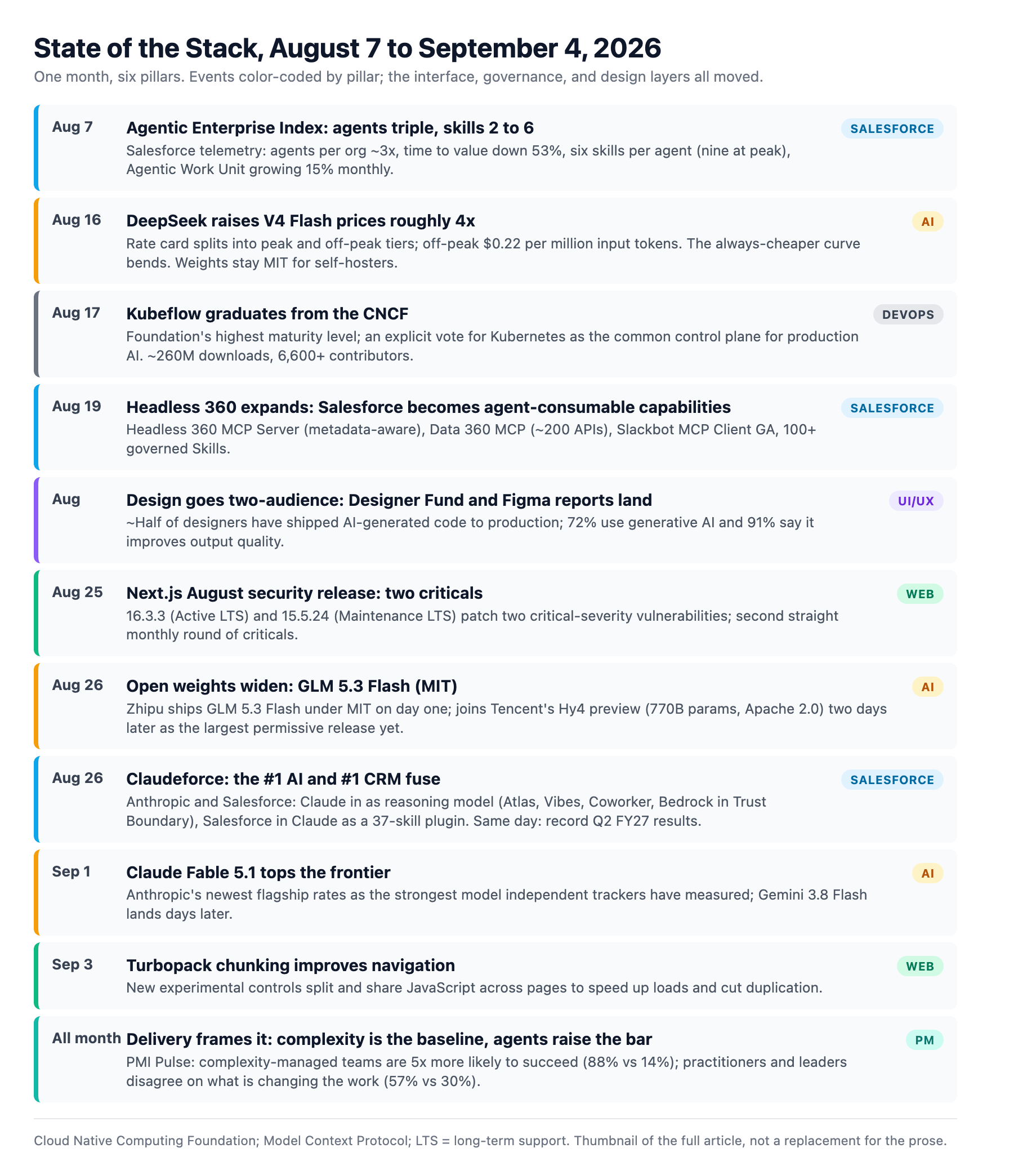
Last month's roundup closed with the claim that the stack was being rebuilt around autonomous agents, and that agent readiness was infrastructure work, not model shopping. August answered that claim with a month of proof. The change stopped being a roadmap and became a product surface: a model maker signed a deal that put its AI inside the number-one CRM and, in the same announcement, put that CRM inside its own client. The platform vendor finished turning its software into capabilities any authorized agent can discover. The operations layer graduated the project that makes Kubernetes the enterprise control plane for AI, and AWS shipped a policy language that governs a whole run of agent tool calls rather than each one in isolation.
Three signals ran under it all. The front office and the frontier model are fusing, so the screen you used to click through is becoming one interface among many. Governance caught up with what agents actually do, which is act in sequences, not single steps. And design is now for two readers at once, humans and the agents that parse a page first. Here is the month, pillar by pillar, with the timeline up front.
Web: security cadence became the job
The Web layer's August headline is not a feature. It is that Vercel kept a promise it made in July, when it moved Next.js to a formal, scheduled security-release process. On August 25 it shipped the August 2026 security release, patching two critical-severity vulnerabilities across the two supported lines at once, 16.3.3 on Active LTS and 15.5.24 on Maintenance LTS 1. This is the second straight month of criticals after a July release that fixed four HIGH and five MEDIUM issues. When a framework moves to a monthly critical-patch cadence, staying current stops being an occasional chore and becomes an operating discipline with a calendar.
The teams shipping the most with AI coding agents are often the most likely to run a month behind on a dependency, because an agent that scaffolds a project pins whatever is current and nobody revisits it. Every agent-assisted build needs a patch-and-audit loop that treats framework security like a rotating certificate, with a renewal date. Vercel also shipped the first real progress on Turbopack chunking, experimental controls to split and share JavaScript across pages and speed up navigation 2. The practical read for a Next.js 16 team is unchanged from our earlier coverage: upgrade to the current LTS patch, wire the cadence into your calendar, and keep agents pointed at version-matched documentation so they do not silently build against a stale API. For the browser-framework fundamentals that sit under all of this, our React 19.2 breakdown is the companion read.
Salesforce: the platform became capabilities, then invited the model in
Two announcements, one week apart, define Salesforce's month, and they are really one architecture told twice.
On August 19, Salesforce expanded Headless 360, the umbrella that turns its clouds from applications into reusable capabilities any authorized agent can discover and invoke 3. The centerpiece is a new Headless 360 MCP Server: metadata-aware, so an agent does not just find endpoints but understands the relationships, permissions, workflows, and validation rules that define how the business actually operates. It sits alongside a Data 360 MCP Server exposing roughly 200 Data 360 APIs, a generally available Slackbot MCP Client reaching Salesforce plus 20 partner applications, and more than 100 reusable Skills that package business logic as governed units. The framing matters: most MCP servers expose APIs; this one exposes trusted business capabilities, so an agent inherits the governance you already built instead of forcing you to recreate it in prompts or glue code. Engine is the cited proof point, standing up an AI support agent in 12 days that now resolves half its customer chats without a human 3.
A week earlier, the 2026 Agentic Enterprise Index quantified the same shift from platform telemetry: activated agents per organization nearly tripled over the fiscal year, time from agent creation to use fell 53%, and the average agent now acts on six skills, up from two at the start of 2025, expanding to nine during peak retail season, a 350% jump 4. Salesforce introduced the Agentic Work Unit as its measure of agent output, and it is growing at a 15% compound monthly rate, led by retail (22% of total output) and travel 4. Pandora's Agentforce concierge handles 60% of routine support requests at peak and lifted Net Promoter Score ten points; Siemens and PenFed show the regulated-industry pattern of fewer, deeper agents 4.
Then came the announcement that tied the architecture to the market. On August 26, the same day it reported record Q2 fiscal 2027 results, Salesforce and Anthropic unveiled Claudeforce, an expanded partnership that runs in two directions at once 56. Claude moves into Salesforce as a reasoning model for the Atlas engine, default in Agentforce Vibes and Coworker, served through Amazon Bedrock inside the Salesforce Trust Boundary so regulated customers keep data and inference in one security perimeter. And Salesforce moves into Claude as Salesforce in Claude, a plugin with 37 prebuilt sales skills, from meeting prep to deal-health review to pipeline updates, governed by the permissions the org already runs on. The pitch, from Marc Benioff and quoted across the release, is that the UI is becoming the AI and that software is turning from the interface into a system that powers every interface 5. Claude is now the default model across Salesforce's own Slack, Slackbot, and engineering stack, and Salesforce reports Slackbot driving 8.1 million hours of annualized productivity gains internally 5.
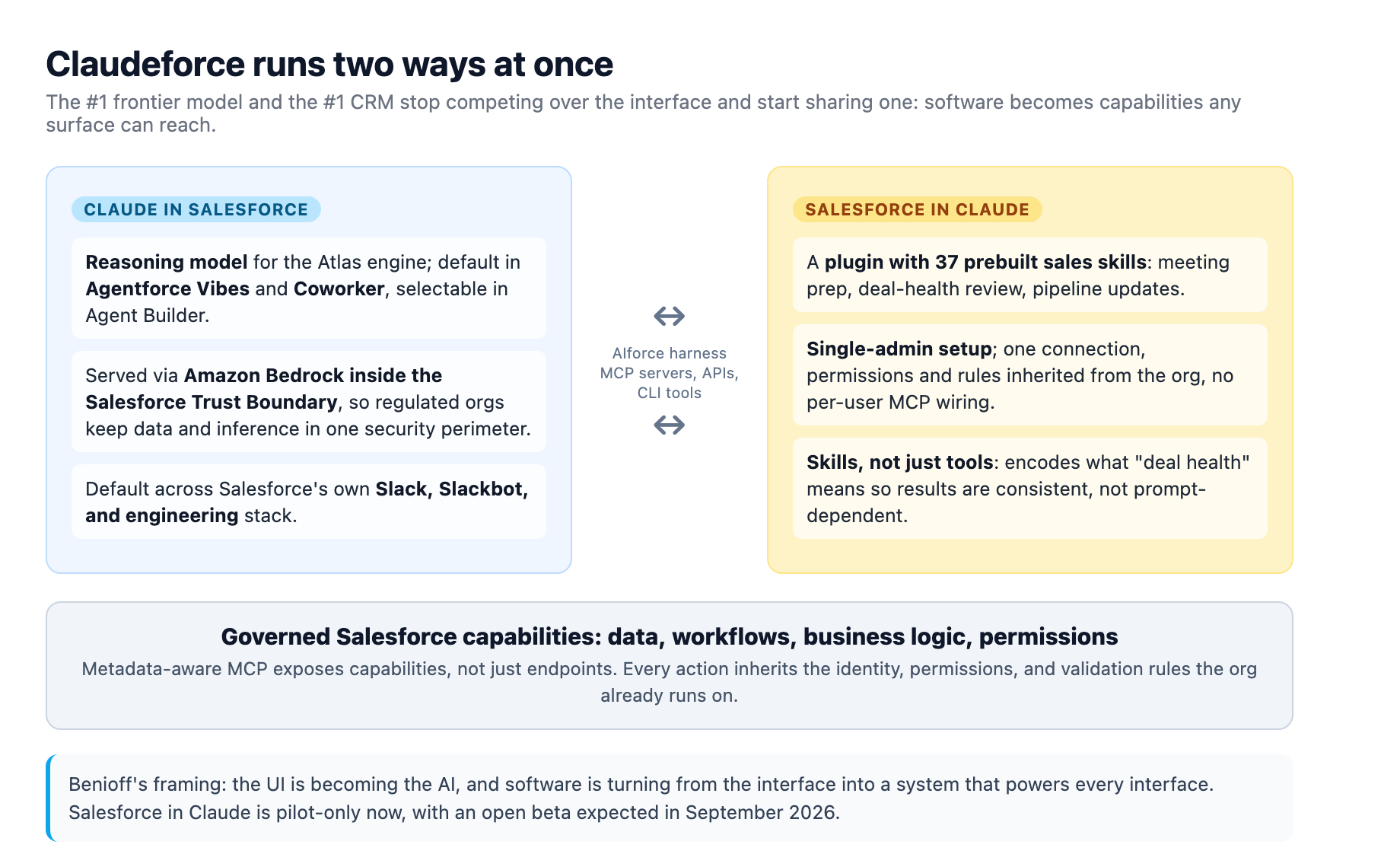
For clients, the through-line across all three stories is consistent: the CRM you bought as a set of screens is becoming a set of addressable capabilities, and the model that reads them is now a first-class partner with its own interface. That changes the integration question from "which UI do I build" to "which capabilities do I expose, to which agents, under which rules." Our Salesforce MCP hosting guide, the stateless MCP migration walkthrough, and the Data Cloud personalization pattern all assume exactly this headless, agent-consumable shape.
AI: the frontier widened, and the price curve bent
August to early September was a release-heavy stretch for models, but two structural moves matter more than any single launch. First, open weights kept closing the gap. Tencent shipped Hy4 preview on August 28, a 770-billion-parameter model released under Apache 2.0, among the largest permissively licensed models published, and Zhipu followed with GLM 5.3 Flash under an MIT license on August 26 7. These sit on top of a year where self-hosting moved from experiment to viable, and they are the models a team points its local infrastructure at when the ceiling question is about cost and control rather than capability. Second, the always-cheaper trend reversed. DeepSeek raised its V4 Flash prices roughly fourfold on August 16, splitting the rate card into peak and off-peak tiers, with off-peak at $0.22 per million input tokens 7. Self-hosters are unaffected because the weights stay MIT, but anyone renting the API got a reminder that a cost floor can move up as well as down. On the frontier side, Anthropic shipped Claude Fable 5.1 on September 1, which independent trackers rate as the strongest model measured so far, and Google's Gemini 3.8 Flash landed days later 7. The engineering note is less about which model leads and more about what these three things together mean: model choice is an active procurement decision again, the open-weight floor keeps the total bill honest, and the model a team picks now threads through the whole stack, up to and including the CRM surface described above.
DevOps: the AI control plane graduated, and policy learned sequences
Two moves, weeks apart, captured the operational story. On August 17 the CNCF announced Kubeflow's graduation, the foundation's highest maturity level 8. Kubeflow's graduation is not a win for one tool; it is an explicit industry vote that Kubernetes can be the common control plane for building, operating, and governing production AI, a role it was never designed for but has been growing into. The graduated project bundles Kubeflow Pipelines for portable workflows, Trainer for distributed training and fine-tuning, Katib for tuning, Notebooks, Spark Operator, and the model registry, with nearly 260 million Python downloads and more than 6,600 contributors behind it 8. Bloomberg, NVIDIA, Red Hat, LinkedIn, and Spotify use Kubeflow subprojects to standardize their AI workloads 8. The read for platform teams: if you already standardize on Kubernetes, the AI layer is maturing into a set of native abstractions you can adopt piece by piece, not a separate stack you have to buy.
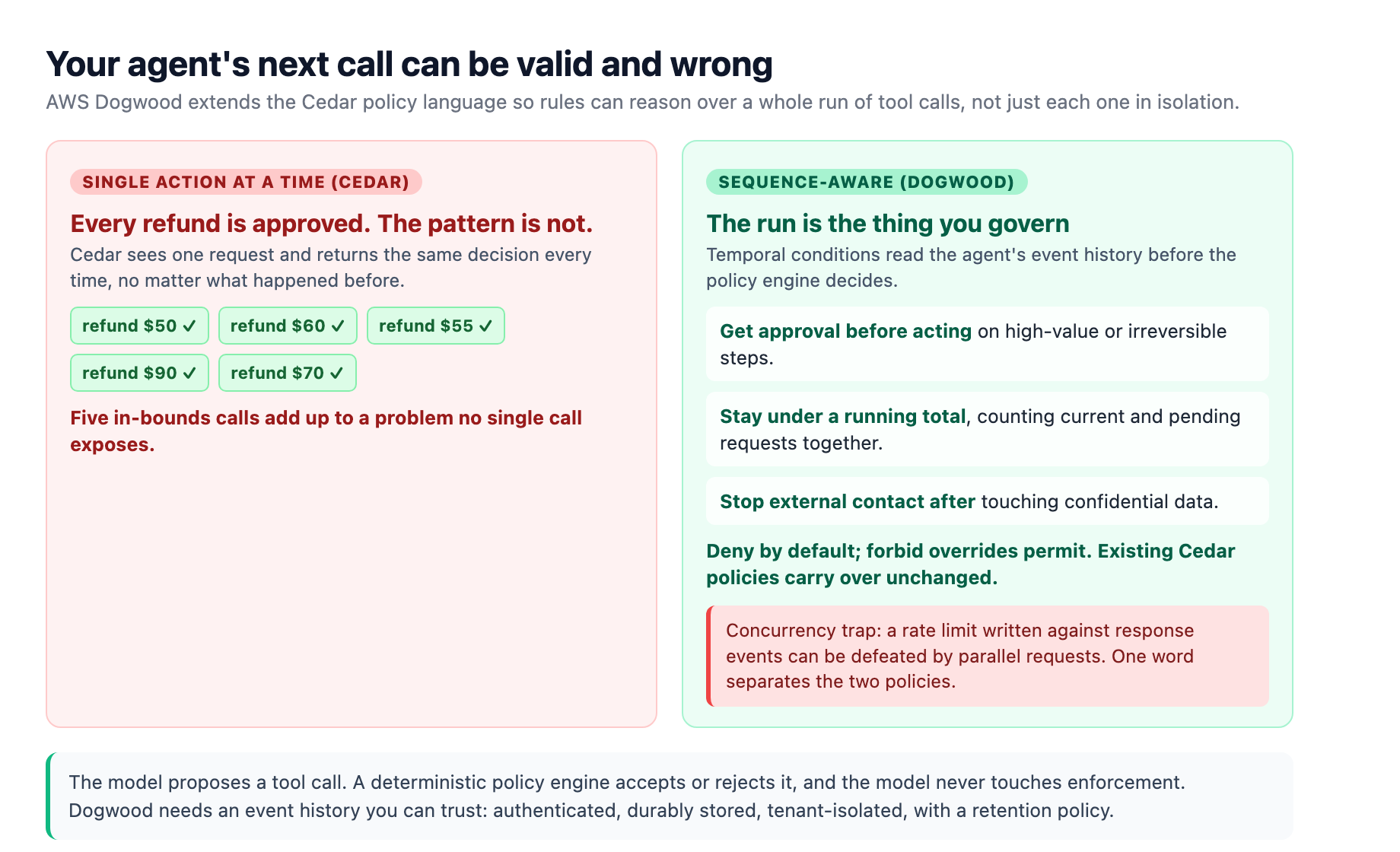
The second move answered a governance gap that the agent-security posts have been circling all year. On August 6 AWS open-sourced Dogwood, an Apache-2.0 policy language that extends its Cedar authorization language with temporal conditions 9. Where Cedar judges one request in isolation, Dogwood can look backward at what the agent already did, which is where the real constraints live: get approval before acting, stay under a running total, do not contact an external party after touching confidential data. AWS is blunt that a rate limit written against response events can be defeated by concurrent requests, and that building an event history you can trust is a prerequisite, because the policies mean nothing without authenticated, durably stored, tenant-isolated traces 9. Dogwood sits outside the model as a deterministic gate, deny by default, with forbid overriding permit, and existing Cedar policies carry over unchanged 9. It is the direct answer to the class of failures we documented in our agent tool attack-surface and MCP security deep-dives: single actions that look fine and a pattern that is not.
UI/UX: designing for two readers
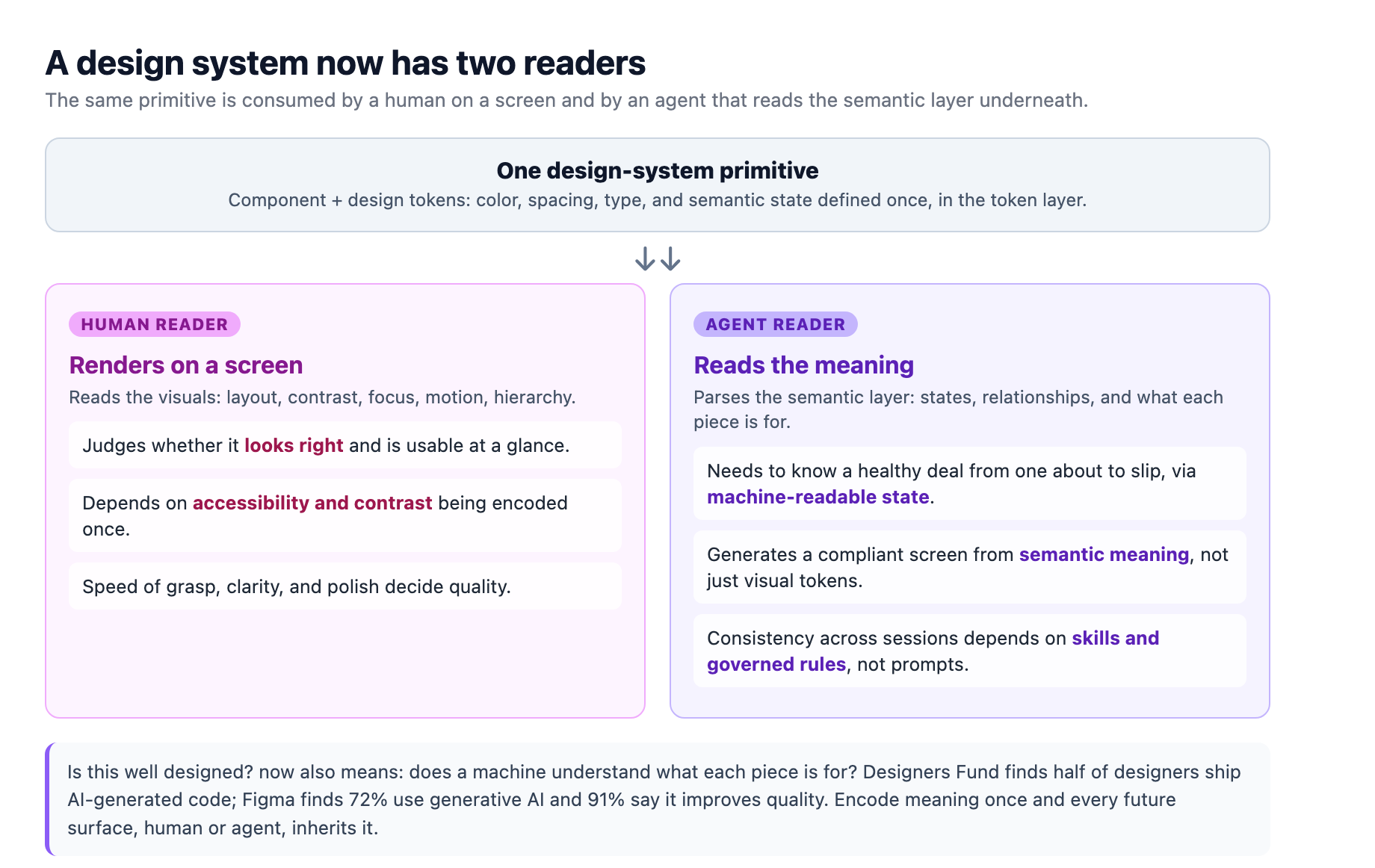
The design layer produced two serious data points this month. Designer Fund's AI in Design 2026 report, built on more than 900 designers across 60-plus countries, found half of respondents have pushed AI-generated code to production and that designers now use double the number of off-the-shelf tools they did a year ago 10. Figma's State of the Designer 2026, surveying 906 designers, reports that 72 percent use generative AI in their workflow and 91 percent say it improves the quality of their output, not just its speed 11.
The interesting part is what those numbers point at, not the numbers themselves. A design system that used to be documentation for human developers is becoming a substrate that two very different readers consume. A human reads a rendered component. An agent reads the semantic layer underneath, the tokens, the states, the machine-readable meaning that lets it generate a screen that follows the rules. This is the shift our token-first design-system piece and our headless UI analysis have been circling: when the primary consumer of your interface can be an agent, "is this well designed" stops meaning only "does it look right on a screen" and starts meaning "does a machine understand what each piece is for." The skill's own one-question test for a good figure applies to an agent's view of a page: if the machine cannot tell a healthy deal from one about to slip, the interface has not done its job. Teams that encode contrast, focus, and semantic state once, in the token layer, inherit the benefit across every future surface, human or agent, which is the same argument our accessibility work makes for people.
Project Management: complexity is the baseline, and agents raised the coordination bar
The delivery layer did not produce a headline as loud as Claudeforce, but it produced the framing that explains why every other section this month is hard. PMI's 2026 Pulse of the Profession, which we broke down in depth in our complexity deep-dive, found teams that manage complexity effectively are five times more likely to deliver successful projects, with an 88 percent success rate against 14 percent for ineffective teams 12. Its sharpest finding is a perception gap: faster technology and tool cycles are named as a complexity driver by 57 percent of practitioners but only 30 percent of senior leaders 12. When the people doing the work and the people funding it disagree about what is changing the work, the strategy and execution diverge.
Every engineering story in this roundup widens that gap. Agents add new kinds of work to a delivery chain, new handoffs, new failure modes, and new review obligations, and the people managing that chain are exactly the practitioners PMI found naming tool cycles as the problem. The definition of done has to cover what an agent produced, not just what a person did, an argument we made in definition-of-done-ai-agents-2026. If complexity was already the baseline before agents joined the team, it is higher now, and the discipline that separates the 88 percent from the 14 percent is not less automation, it is sharper governance around it.
The Adroit take: what to do with the month
Put the six pillars together and the month reads as one event: the enterprise interface is splitting into many agent-facing surfaces, and the organizations that come out ahead will be the ones that decide, deliberately, which capabilities to expose, to which agents, under which sequence-aware rules. Three moves follow.
First, treat your platform as a set of addressable capabilities, not screens. The Salesforce story is the clearest example, but the principle generalizes: inventory the operations an agent could usefully own, decide which are safe to expose through an MCP-style server, and let the existing permissions and validation rules be the boundary. Second, put governance at the sequence level. Dogwood's lesson, that a single action can be valid while its pattern is not, is the exact failure we have hit in our own multi-agent delivery chain, where one in-bounds tool call is fine and the run of calls that follows it is where the risk lives. Any agent you deploy needs policy that can see the run, an audit trail you trust, and a deny-by-default posture. Third, stop treating model cost as a solved, always-descending curve. DeepSeek's hike and the open-weight wave together mean the economics are a live decision again, and the models thread through your whole stack, so reprice and re-license deliberately.
None of this is a reason to pause. It is a reason to be precise. The interface moved this month, from a screen you open to a capability agents reach, and the teams that rebuild their data, their governance, and their definition of done around that shift are the ones who will be describing next month's roundup instead of reacting to it.
Sources
-
Next.js August 2026 Security Release. nextjs.org ↩
-
How Turbopack chunks your JavaScript. nextjs.org ↩
-
Expanding Headless 360: enterprise capabilities. salesforce.com ↩ ↩2
-
Salesforce Agentic Enterprise Index 2025-2026. salesforce.com ↩ ↩2 ↩3
-
Salesforce and Anthropic announce Claudeforce. salesforce.com ↩ ↩2 ↩3
-
Salesforce delivers record Q2 fiscal 2027 results. salesforce.com ↩
-
Best AI Models in September 2026 (Fello). felloai.com ↩ ↩2 ↩3
-
Introducing Dogwood: runtime verification for AI agents. aws.amazon.com ↩ ↩2 ↩3
-
AI in Design Report 2026 (Designer Fund). stateofaidesign.com ↩
-
PMI Pulse of the Profession 2026: driving success in complex projects. pmi.org ↩ ↩2